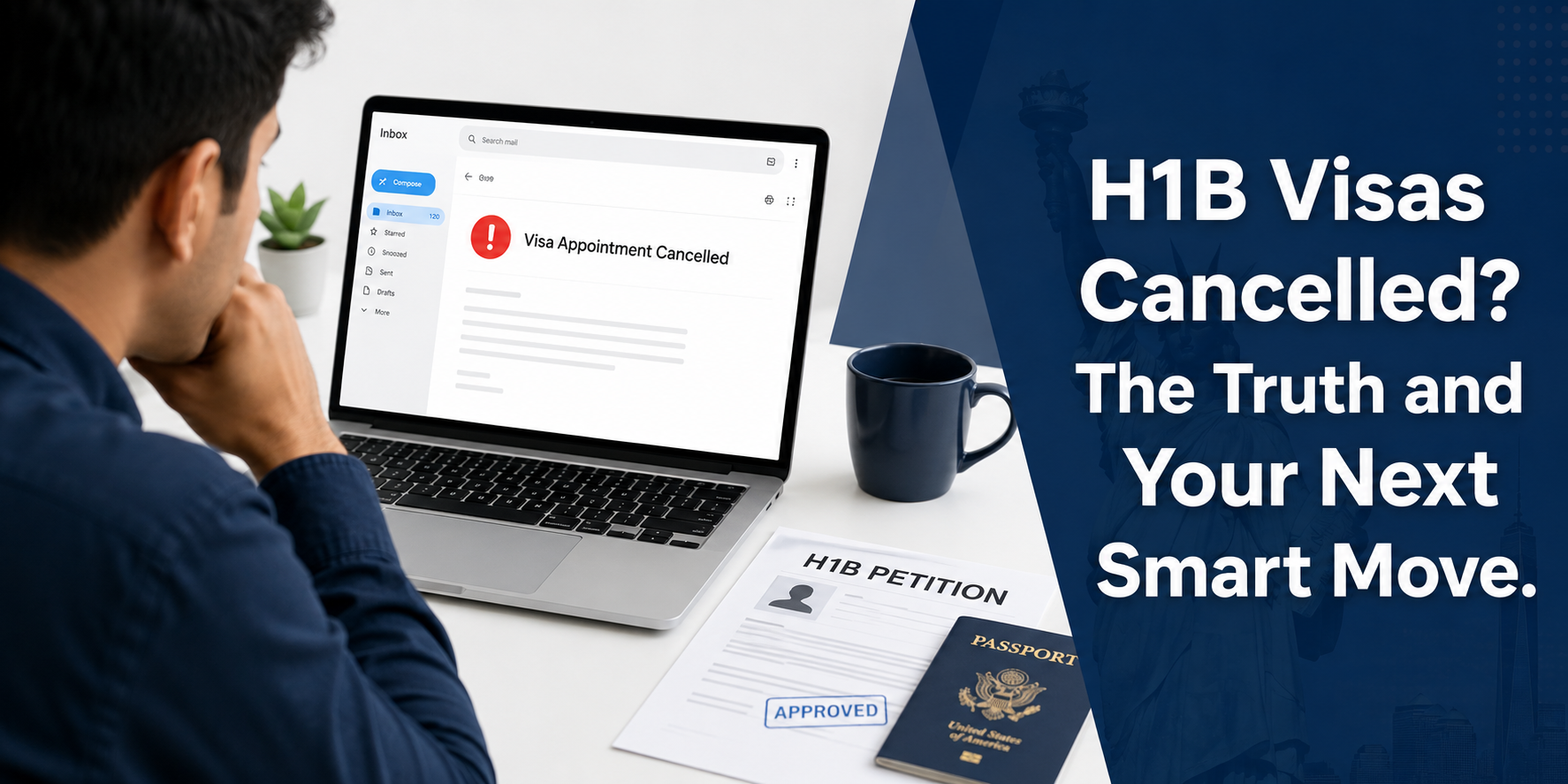
“H1B visas cancelled. Those three words have sent thousands of applicants into a panic. You opened your email, saw the notification, and your stomach dropped. Before you spiral, here is what is actually happening and what you need to do next..
Before you spiral, take a breath. Your visa is not denied. Your petition is not revoked. And you are not alone. Thousands of H1B and H4 applicants received the same email, and most of them do not know why it happened or what to do next.
This guide tells you exactly what is going on, what the difference is between a cancellation and a revocation, who is actually at risk, and what smart applicants are doing with the extra time they now have before their rescheduled interview.
Table of Contents
Are H1B Visas Actually Cancelled? The Short Answer
No. H1B visas have not been globally cancelled. The program is still running. The FY2027 cap has been filled, the lottery has been completed, and USCIS is processing petitions.
What happened is more specific and more manageable than the headlines suggest. Two things are happening simultaneously and people are confusing them for one big catastrophe.
If you are still at the lottery stage and wondering where you stand, our guide on how to check your H1B visa lottery chances breaks that process down separately.
First, thousands of visa interview appointments at US consulates, particularly in India, were cancelled and rescheduled. This was triggered by a policy change, not by any problem with individual applications.
Second, individual petition revocations do happen, but they are not random. They happen for specific, identifiable reasons that we will cover in full below.
If your appointment was cancelled and rescheduled, that is not a red flag on your application. It is an administrative consequence of a new screening policy that the consulates needed time to implement.
Appointment Cancellation vs Global Programme Cancellation: What Is the Difference
A global programme cancellation would mean the US government has ended the H1B visa programme entirely. That has not happened and is not happening.
An appointment cancellation means the specific date and time your interview was scheduled can no longer go ahead as planned. Your case is still active. Your petition is still valid. You simply have a new interview date.
The confusion between these two very different things is exactly why the keyword “H1B visas cancelled” is generating so much panic search traffic right now.
What the Headlines Are Actually Referring To
Most news coverage about H1B cancellations in late 2025 and early 2026 was referring to the mass rescheduling of consular appointments in India following the rollout of mandatory online presence review for H1B and H4 applicants.
The story was real. The scale was significant. But the underlying cause was procedural, not punitive.
Why H1B Visa Appointments Were Cancelled in 2025 and 2026
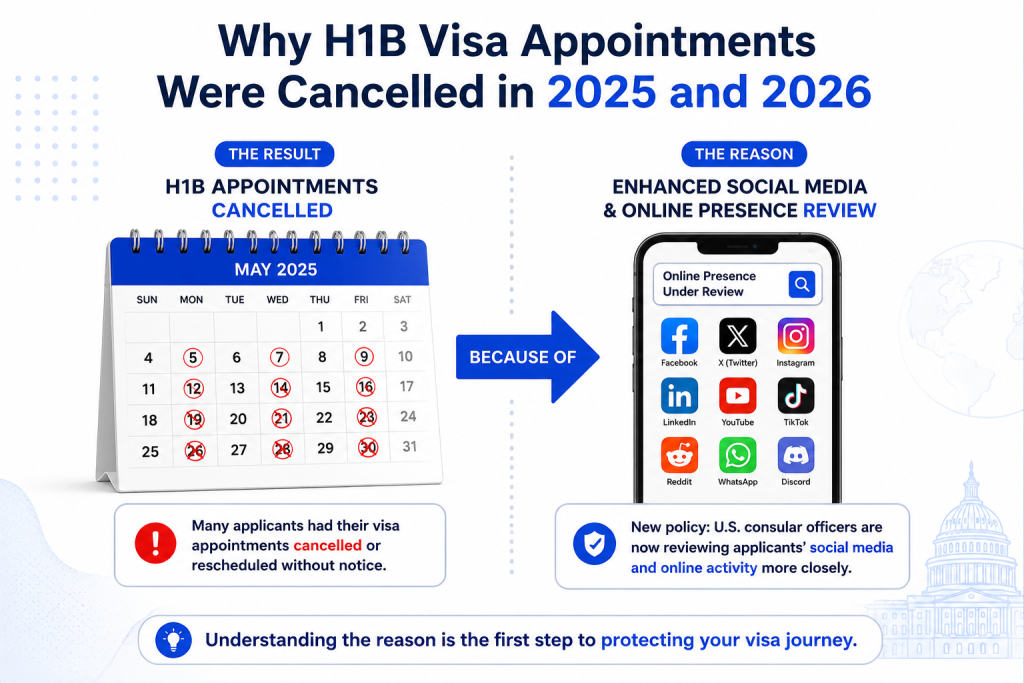
This is the part no competitor article has explained clearly. The appointment cancellations did not happen randomly. They happened for a very specific reason that connects directly to something you now need to prepare for at your rescheduled interview.
The Social Media Screening Expansion for H1B and H4 Applicants
Starting December 15, 2025, the US Department of State rolled out mandatory online presence review for H1B and H4 visa applicants. This means consular officers are now required to review the publicly visible social media accounts of every H1B and H4 applicant before or during their visa interview.
This is not a quick checkbox. It takes time. Each review involves checking your disclosed social media accounts against the details on your visa application: your employment history, your job title, your educational background, your location history, and your behavioral signals online.
Because each interview now takes significantly longer than it did before, consulates can process fewer applicants per day. To accommodate the new processing pace, appointments that had already been scheduled needed to be moved to later dates.
Your appointment was not cancelled because something is wrong with your application. It was cancelled because the consulate needed to reset its schedule to account for longer processing times per applicant.
Why Consular Posts in India Were Hit First
The cancellations were concentrated at US consular posts in India because India has the highest volume of H1B visa applicants globally. When the processing time per applicant increases, the backlog at high-volume posts becomes immediately visible.
Cancellations were reported across multiple US consulates in India, with many applicants receiving rescheduled dates as far out as March 2026. Other consular posts outside India were also expected to implement similar rescheduling as the online presence review policy rolled out further.
What the Rescheduled Dates Mean for Your Case
Your rescheduled date is not a demotion or a penalty. It is simply a new slot in a queue that got longer overnight.
What it is, however, is a window of time you can use strategically. Applicants who understand what the rescheduled interview now involves, and who prepare properly for the social media screening component, are in a significantly stronger position than those who simply wait for the new date to arrive.
We will cover exactly how to use that time later in this guide.
The Difference Between Cancelled, Revoked, Denied, and Withdrawn
These four words are being used interchangeably in forums and on social media, and that is causing enormous confusion. They mean completely different things and have completely different implications for your case.
Appointment Cancellation
Your interview date was moved. Your petition is still valid. Your case is still active. Nothing about the underlying application has changed. This is the situation most H1B applicants currently face.
Petition Revocation
This is significantly more serious. A revocation is the official cancellation of an already approved H1B petition by USCIS, or the cancellation of a valid H1B visa stamp by a US consulate abroad. A revocation invalidates the underlying approval. It means the government has determined that the basis for your visa no longer exists or was flawed.
Revocations do not happen without a formal process. USCIS issues a Notice of Intent to Revoke (NOIR) before any final revocation, giving the petitioner a chance to respond. We cover this process in detail below.
Visa Denial
A denial happens before a visa is issued. It means your application was reviewed and rejected. You never received the visa in the first place. If your appointment was cancelled and rescheduled, you are not in denial territory. You have not even had your interview yet.
Petition Withdrawal
A withdrawal is an action taken by the employer, not the government. If your employer terminates your employment or you leave the company, the employer is required to notify USCIS and withdraw the petition. A withdrawal often leads to USCIS initiating revocation proceedings because the employment relationship that was the foundation of the petition no longer exists.
Understanding which of these four situations applies to you is the first step in knowing what to do next.
When Can USCIS Actually Revoke an H1B Visa?
Revocations are not random. They happen for specific reasons, and understanding those reasons is your best protection against them.
Employment Termination
This is the most common trigger. If your employer terminates your employment or you resign, the employer must notify USCIS. Once USCIS is informed that the employment relationship no longer exists, they will move to revoke the petition.
This is why layoffs in the tech sector have generated so much anxiety around H1B status. The layoff itself does not revoke the visa. But the employer’s subsequent petition withdrawal, followed by USCIS action, does.
If you lose your job while on H1B status, you generally have a 60-day grace period to find a new employer and file a new petition before you fall out of status.
Fraud or Misrepresentation
If USCIS or a consular officer discovers that your petition contained false information or material misrepresentations, whether from you or your employer, revocation is almost certain. This includes false educational qualifications, fabricated work experience, inaccurate job duties, or misrepresentation of the employer-employee relationship.
This is also where social media screening becomes directly relevant. If your LinkedIn profile describes your job title or responsibilities in a way that contradicts what your H1B petition states, that inconsistency will be visible to the consular officer reviewing your accounts.
Employer Non-Compliance
Employers have specific obligations under the H1B programme. Violating those obligations can lead to USCIS initiating revocation. The most common compliance failures include:
Failure to pay the prevailing wage for the role and location. Employers must pay H1B workers at least the prevailing wage for their occupation. Underpayment is a serious and frequently audited violation.
Failure to maintain Public Access Files. Employers must keep specific documentation related to H1B employment and make it available for public inspection.
Significant changes to employment terms without filing an amended petition. If your job duties change substantially, your work location changes, or your role evolves in a way that affects the specialty occupation classification, an amended petition may be required.
Site Visits and Investigations
USCIS conducts unannounced site visits to H1B employers to verify the information provided in petitions. These visits confirm that the employer exists, that the H1B worker is present, that the job duties match the petition, and that wage requirements are being met.
If a site visit reveals discrepancies, USCIS can initiate a NOIR and ultimately revoke the petition. Transparency and accurate documentation are your best protection here.
Policy or Law Changes
Changes in immigration policy can affect how existing visa categories are administered, though full revocations based purely on policy changes are rare for already-approved petitions. What is more common is stricter interpretation of existing rules, more rigorous scrutiny during site visits, and increased requests for evidence during petition renewals.
The current political and regulatory environment makes staying informed more important than ever.
What Happens If You Receive a Notice of Intent to Revoke
A NOIR is not a final revocation. It is a formal warning from USCIS stating their intention to revoke and explaining why. It is your opportunity to respond and fight back.
What a NOIR Is and What It Means
The NOIR is sent to the petitioner, which is the employer, not the employee directly. It outlines the specific reasons USCIS believes the petition should be revoked, citing the relevant immigration statutes or regulations they believe have been violated.
If you are the H1B beneficiary and your employer informs you they received a NOIR, take it seriously immediately. Do not wait.
How Long You Have to Respond
Upon receiving a NOIR, the petitioner typically has 30 days to submit a response. This response must present evidence and legal arguments that counter USCIS’s stated basis for revocation.
This is not the moment for a DIY approach. A well-constructed NOIR response requires knowledge of immigration statutes, precedent decisions, and the specific evidence USCIS needs to see. Immigration legal counsel is not optional at this stage.
Your Options After a Final Revocation
If USCIS issues a final revocation after reviewing the NOIR response, your options include:
Change of status. If you are eligible for another visa category such as O-1, F-1, or H-4, you may be able to file a change of status petition. This requires immediate action and careful eligibility assessment.
Finding a new employer. If the revocation was triggered by employment termination, finding a new H1B-sponsoring employer and filing a new petition is the most common path forward. Under H1B portability rules, you can begin working for a new employer once a new, non-frivolous H1B petition is filed, provided this happens before you accrue unlawful presence.
Voluntary departure. If no other option is available, departing the US voluntarily before accruing unlawful presence preserves your ability to apply for future visas without the additional burden of an overstay on your record.
You typically have a 10-day grace period after a revocation becomes final, though this is not guaranteed. Every day matters.
Who Is Most at Risk Right Now
Not every H1B applicant faces the same level of risk. Here is an honest breakdown of who should be paying the most attention right now.
Applicants With Rescheduled Interviews
If your interview was rescheduled due to the social media screening expansion, your risk is not elevated by the cancellation itself. However, you now face a more rigorous interview process than applicants who went through before December 15, 2025. Your online presence will be reviewed. Your application details will be cross-checked against your social media profiles.
Applicants who have inconsistencies between their LinkedIn, their DS-160, and their H1B petition details are in a more vulnerable position than those whose records are fully aligned.
H1B Holders Whose Employers Have Downsized
Tech sector layoffs, restructuring, and company closures have affected thousands of H1B holders. If your employer has reduced headcount, changed your role significantly, or shifted your work location, your petition may need to be amended. If your employment has ended, the 60-day grace period clock is running.
Applicants With Inconsistencies Between Their Application and Online Presence
This is the risk category that VizaCheck was built to address, and it is the one most applicants do not think about until it is too late.
If your LinkedIn profile lists a job title different from the one on your H1B petition, that is a consistency flag. If your social media accounts suggest a lifestyle or location that does not match your declared information, that is a behavioral signal. If your employment history on your application contradicts what is publicly visible on your professional profiles, a consular officer reviewing your accounts before your interview will see it.
These are not hypothetical risks. They are exactly the kinds of signals the social media screening process was designed to surface.
How to Use the Extra Time Before Your Rescheduled Interview
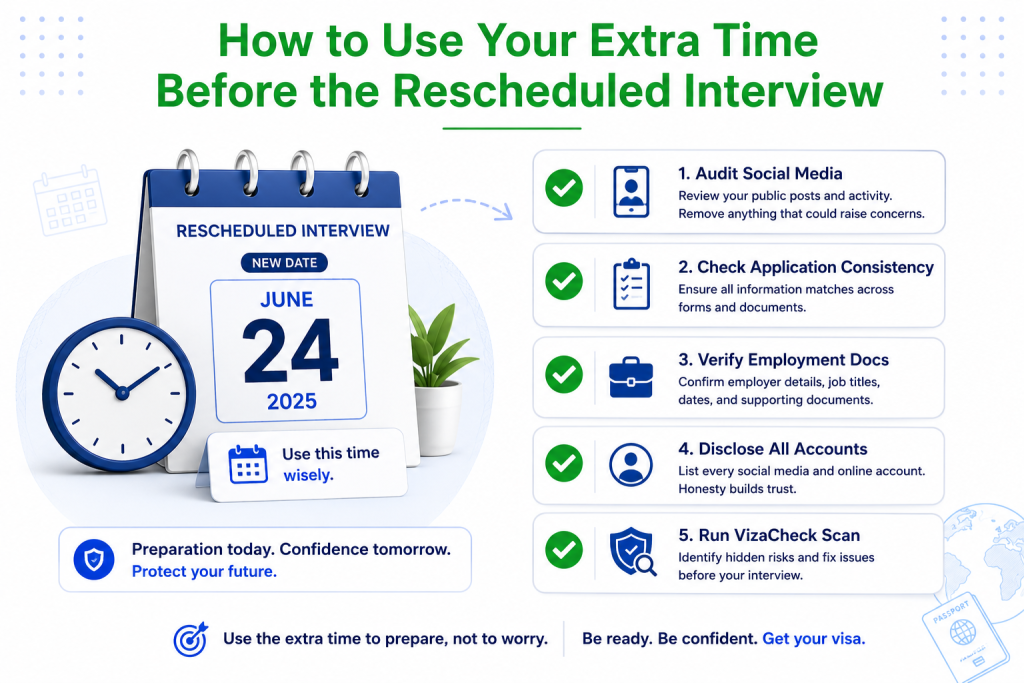
Your rescheduled interview date is not a setback. It is preparation time. Here is how to use it.
Step 1: Audit Your Social Media Accounts
Go through every platform you have used in the past five years. Search your own name in a browser you are not logged into. See what a stranger, or a consular officer, would see when they look at your public profile.
Check that your name, location history, employment details, and educational background are consistent across every platform. Look for anything that could be read as inconsistent with your H1B petition details.
Step 2: Check Your Application Consistency
Pull out your H1B petition and your DS-160. Compare the job title, job duties, employer name, and work location against what appears on your LinkedIn profile and any other professional platforms.
Small differences are normal. Major contradictions are dangerous. A different job title, a different employer, or a completely different professional narrative between your petition and your public profile will raise questions at your interview.
Step 3: Verify Your Employment Documentation
Confirm with your employer that your LCA is current, your prevailing wage is being met, your Public Access File is in order, and any material changes to your employment have been captured in an amended petition if required.
Do not assume your employer has handled all of this. Ask directly. The consequences of non-compliance land on you as much as on the employer.
Step 4: Disclose All Social Media Accounts Accurately
When you reach the social media section of your visa application, list every platform and every handle you have used in the past five years. Exactly as it appears on the platform. Including accounts that are inactive or that you use under a different name.
An undisclosed account that a consular officer finds during their review is a far bigger problem than anything that account actually contains.
Step 5: Let VizaCheck Scan What You Might Miss
Most applicants only check the accounts they actively use. They do not check older accounts, forgotten platforms, or content that has been shared or attributed to them beyond their primary profiles.
VizaCheck’s pre-submission risk intelligence scan does exactly this. It reviews your publicly visible digital footprint across platforms, cross-checks it against your application details, flags inconsistencies before they reach a consular officer, and gives you a prioritized list of issues to address before your rescheduled interview.
The applicants who walk into their rescheduled H1B interview with a VizaCheck report in hand are not hoping their online presence looks fine. They know it does. That is the difference between anxiety and confidence.
Run your VizaCheck pre-submission scan before your rescheduled interview date. Know your risk score before the embassy does.
Your appointment being cancelled is not the end of your H1B journey. It is a detour caused by a policy rollout that caught thousands of applicants off guard. The consulates are not targeting you. USCIS is not coming for your petition. The system is adjusting to a new level of scrutiny that now applies to everyone in your visa category.
What separates applicants who sail through their rescheduled interview from those who hit complications is preparation. The applicants who understand what officers are now checking, who have aligned their online presence with their application details, and who have identified and resolved inconsistencies before the interview, are in a completely different position from those who simply show up and hope for the best.
You now have time. Use it.
Start your VizaCheck pre-submission risk scan today and walk into your rescheduled interview knowing exactly what the officer will find, because you already checked it yourself.
Has the H-1B visa been cancelled?
No, the H-1B visa programme has not been cancelled. It is still active and USCIS continues to process petitions. What happened is that thousands of H-1B and H-4 visa interview appointments were cancelled and rescheduled, mainly at US consulates in India, following the rollout of mandatory social media screening for these applicants in December 2025. The cancellations were administrative, caused by longer processing times per interview under the new policy. Your petition remains valid if your appointment was rescheduled.
Who has to pay $100,000 for an H-1B visa?
No one is paying it yet. A proposed rule sought to require certain employers to pay a $100,000 fee per H-1B petition, targeting companies that rely heavily on H-1B workers. The proposal was legally challenged and courts blocked its implementation while the matter is under administrative review. As of now the fee has not been enforced. Employers should monitor USCIS announcements closely as this could change depending on how the legal proceedings unfold.
Which countries are banned from the H-1B visa?
No countries are formally banned from the H-1B visa programme. The H-1B is open to qualified workers from any country. However, nationals from India and China face significantly longer waits for employment-based green cards due to per-country caps on visa numbers, which creates a practical bottleneck even after H-1B approval. Additionally, applicants from countries subject to specific US travel restrictions or security-related proclamations may face additional scrutiny or processing delays at the consular stage.
Why are H-1B visas getting revoked?
H-1B visas are not being revoked randomly. Revocations happen for specific reasons. The most common is employment termination, where an employer withdraws the petition after a layoff or resignation, prompting USCIS to revoke the approval. Other reasons include fraud or misrepresentation on the original petition, employer non-compliance such as failure to pay the prevailing wage or maintain required documentation, and discrepancies uncovered during unannounced USCIS site visits. The expanded social media screening policy has also introduced a new risk layer, where inconsistencies between an applicant’s online presence and their petition details can trigger further scrutiny during the consular interview stage.
What happens to my H-1B status if my company gets acquired?
It depends on the type of acquisition. If the new company is considered a successor in interest, meaning it assumes the assets, liabilities, and business operations of the original employer, your H-1B status may continue without requiring a new petition. However, if the acquisition results in significant changes to your job duties, work location, or employment terms, an amended petition may need to be filed. Your status does not automatically transfer in all scenarios. The safest step is to have your employer consult an immigration attorney immediately after any merger or acquisition to assess whether action is required on your petition.