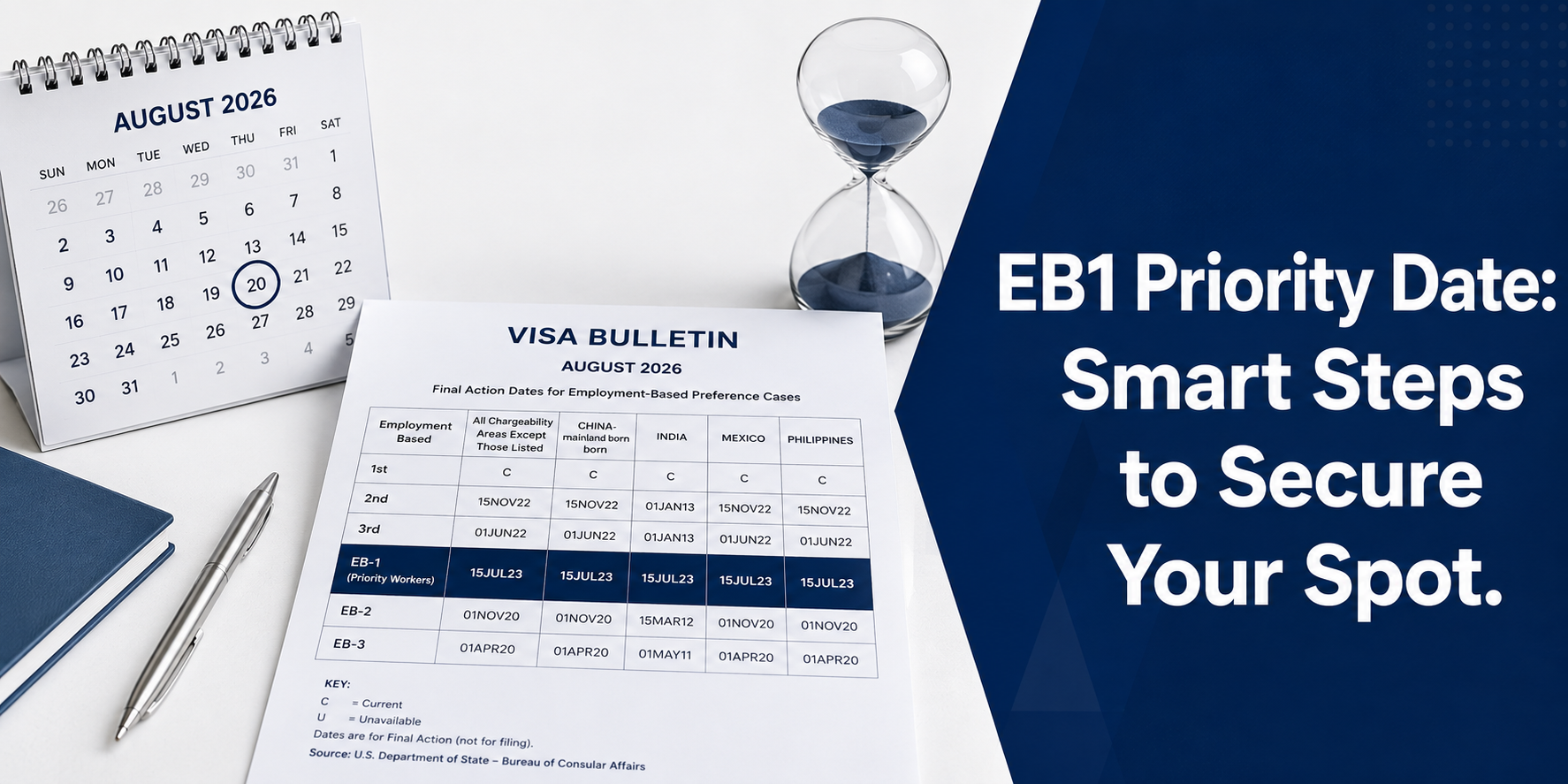
EB1 priority date updates can change everything for applicants who have been waiting years for this moment. Every month you open the visa bulletin, scroll straight to the EB-1 row, and check the date. This month, August 2026, the number matters more than ever
The State Department has issued a warning. The EB-1 category for certain high-demand nationalities, including India, may become unavailable in the coming weeks. That means the window you have been waiting for could close before you know it.
This guide gives you the current EB-1 priority date, explains exactly what it means for your case, and tells you what to do right now if your date is current. Not next month. Now.
Table of Contents
EB1 Priority Date: What the August 2026 Bulletin Says Right Now
The August 2026 Visa Bulletin has been published and the numbers are in.
August 2026 Final Action Date for EB-1
The Final Action Date for EB-1 in August 2026 for applicants born in India is October 15, 2022. All other countries remain current.
This means if your EB-1 priority date is on or before October 15, 2022, your date is current and you may be eligible to file your adjustment of status application or receive your immigrant visa right now.
If your priority date is after October 15, 2022, you are not yet current and must continue to wait.
USCIS has confirmed it will accept employment-based adjustment of status applications based on the Final Action Dates chart for August 2026.
How This Compares to Last Month
The EB-1 Final Action Date for India did not advance in August 2026. It remains at October 15, 2022, the same position it held in July 2026.
No movement this month means the queue has not opened up further for new applicants. If you were not current last month, you are not current this month either. However, the more pressing issue is not advancement. It is the warning about what happens next.
What the October 15, 2022 Date Actually Means for You
The priority date on a visa bulletin is not a filing deadline. It is a queue position. Think of it like a ticket number at a government office. The bulletin tells you which ticket numbers are now being served.
You Are Current If Your Priority Date Is Before October 15, 2022
If the date on your approved I-140 petition is on or before October 15, 2022, your priority date is current. This means a visa number is available for your category and you can move forward with the next step of your green card process, either filing an I-485 adjustment of status if you are in the US, or completing consular processing abroad.
Being current does not mean approval is guaranteed. It means the queue has reached your position and you are now eligible to file. What happens after you file depends entirely on the quality and consistency of your application.
You Are Not Current If Your Priority Date Is After October 15, 2022
If your I-140 priority date is any date after October 15, 2022, you are still waiting. Your date has not been reached yet. You cannot file your I-485 or proceed with consular processing until the bulletin advances to your date.
Given the State Department’s warning about potential unavailability, applicants in this position should stay closely informed and be ready to act the moment their date becomes current.
Final Action Date vs Dates for Filing: Which Chart Applies
This is where many applicants get confused, and getting it wrong can mean filing too early, filing too late, or missing a window entirely.
What the Final Action Date Chart Means
The Final Action Date chart lists the cutoff dates for when USCIS can actually approve your green card application. If your priority date is before the Final Action Date in your category, a visa number is available and your application can be approved.
What the Dates for Filing Chart Means
The Dates for Filing chart sometimes allows applicants to submit their I-485 earlier than the Final Action Date, even when a visa number is not yet technically available. This allows applicants to begin the adjustment of status process and access certain benefits like work authorization while waiting for their final approval.
Which One USCIS Is Using for August 2026
For August 2026, USCIS has directed all employment-based applicants to use the Final Action Dates chart, not the Dates for Filing chart.
This is critical. It means you cannot file early based on the Dates for Filing chart this month. You must have a priority date that is on or before October 15, 2022 to file your I-485 in August 2026.
It is also worth knowing that as part of the current visa screening environment, social media accounts are now reviewed as part of the adjudication process for employment-based applications. Understanding what consular officers look for can help you prepare. Our guide on US visa social media screening covers exactly what gets checked and how to make sure your online presence does not create unnecessary delays in your case.
The EB-1 Unavailability Warning: How Urgent Is It
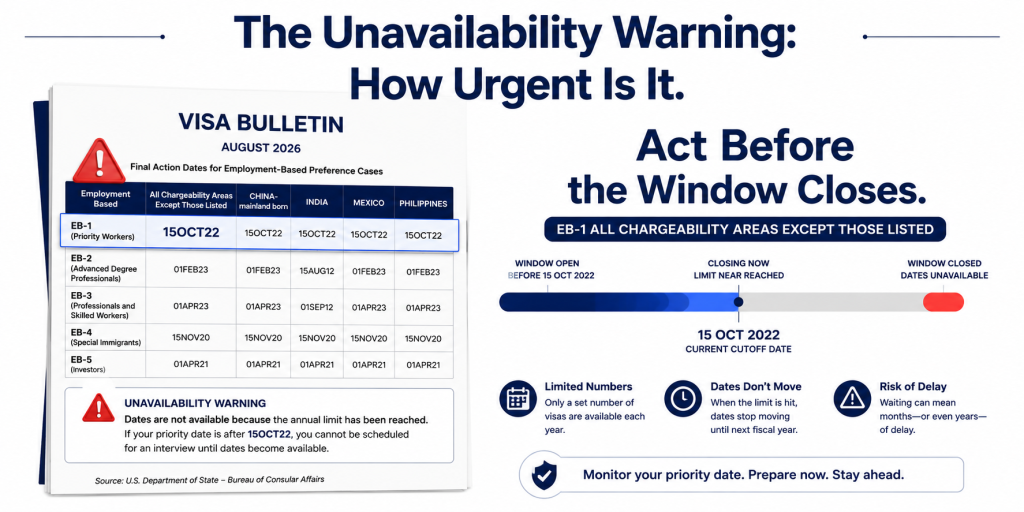
This is the most important development in the August 2026 bulletin for EB-1 applicants, and it is the part most people are not paying enough attention to.
What the State Department Warning Actually Said
The Department of State issued an explicit warning alongside the August 2026 bulletin stating that the EB-1 category for high-demand nationalities may become unavailable later in the fiscal year due to significant usage of visa numbers and continued high demand.
In plain English: the visa number supply is running low. If demand continues at its current pace, USCIS may stop accepting new EB-1 applications for affected nationalities before the end of the fiscal year.
What Unavailability Means for Applicants Who Have Not Filed Yet
If you are currently eligible to file and you do not act before EB-1 becomes unavailable, you will lose your filing window. You will not be able to submit your I-485 or proceed with consular processing until visa numbers become available again, which could mean waiting months into the next fiscal year.
This is not a hypothetical. It has happened before. The warning from the State Department is not routine language. It is a signal to act now if your priority date is current.
What Unavailability Means for Applicants Who Have Already Filed
If you have already submitted your I-485 adjustment of status application and EB-1 subsequently becomes unavailable, your application will not be rejected. USCIS will hold it and continue processing when visa numbers become available again. Your place in the queue is preserved from the date your application was received.
This is exactly why filing as early as possible when your date is current matters so much. An application that is already in the system is protected in a way that an unfiled application is not.
What Is Retrogression and Could It Affect Your EB-1 Case
Retrogression is one of the most feared words in the green card backlog community, and for good reason.
How Retrogression Works
Retrogression happens when the State Department moves a priority date backward in a subsequent visa bulletin. This means a date that was current this month may no longer be current next month. Applicants who were eligible to file suddenly find themselves pushed back into the waiting queue.
Retrogression happens when USCIS approves more applications than anticipated in a given month, causing the visa number supply to deplete faster than expected. To manage the remaining supply, the State Department pulls the cutoff date back.
Has EB-1 Retrogressed Before
Yes. The EB-1 category, which was historically current for all nationalities, has experienced retrogression for high-demand countries in recent years as backlogs from employment-based categories have grown significantly. The category moving from current to a specific cutoff date is itself a form of retrogression relative to where it once was.
The State Department’s warning in the August 2026 bulletin suggests that further retrogression or outright unavailability is a genuine near-term risk, not a distant possibility.
What to Do If Retrogression Hits After You File
If you have already filed your I-485 before retrogression occurs, your application remains pending and your work authorization and travel documents can still be issued or renewed. Your case does not get rejected because of a subsequent retrogression. USCIS simply pauses final adjudication until visa numbers are available again.
If you have not yet filed when retrogression hits, you must wait until the date advances again to your priority date before you can submit.
What To Do Right Now If Your Priority Date Is Current
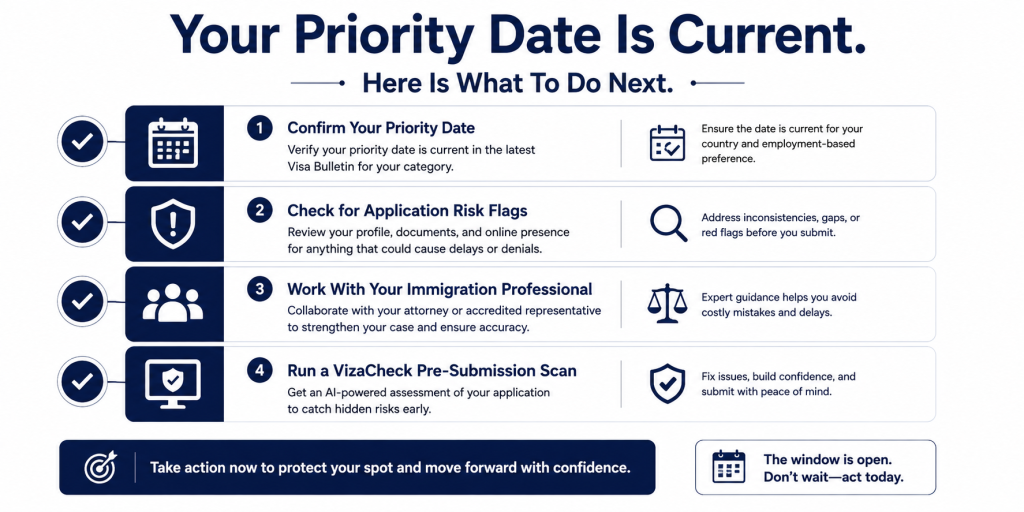
If your EB-1 priority date is on or before October 15, 2022, you are in a critical window. Here is how to move through it correctly.
Step 1: Confirm Your Priority Date Against the Final Action Chart
Pull out your approved I-140 approval notice. The priority date is printed on it. Compare it against October 15, 2022. If your date is earlier, you are current. If it is the same date, you are current. If it is later, you are not yet current.
Do not rely on memory for this. Check the physical document.
Step 2: Ensure Your Application Has Zero Risk Flags
This is where most applicants lose time they do not have. A filing error, a consistency issue between your supporting documents, or a discrepancy between your employment history and your I-140 petition details can result in a Request for Evidence that delays your case by months.
Given the current warning about potential unavailability, a delayed application is not just inconvenient. It could mean your case sits unresolved while visa numbers dry up.
Your immigration professional needs to submit an application that is clean, consistent, and fully supported before it goes in. There is no room for avoidable errors in this window.
Step 3: Work With Your Immigration Professional to File Immediately
Do not attempt to navigate an I-485 filing in a tight visa bulletin window without professional guidance. An experienced immigration consultant or attorney will know exactly what documents are required, how to handle any complications in your employment or travel history, and how to structure your application to minimise the risk of an RFE.
The difference between a smooth approval and a months-long delay often comes down to the quality of the initial submission.
How VizaCheck Helps Your Agent Submit a Clean Application in This Window
Immigration professionals who use VizaCheck to review their clients’ applications before submission are not guessing about whether a case is ready to file. They know.
VizaCheck’s Application Consistency Engine cross-checks visa forms for contradictions, aligns employment, travel, and education history across documents, and applies country-specific embassy logic to flag issues before they reach a USCIS officer. The Social Media Risk Intelligence layer identifies content and behavioral signals that could raise credibility questions during adjudication. The Document Intelligence layer runs financial pattern analysis and employment verification to ensure every supporting document tells a consistent story.
When your priority date is current and the unavailability warning is already in print, the cost of a single avoidable error is enormous. A VizaCheck pre-submission scan gives your immigration professional the confidence to file knowing the application has been reviewed across every risk layer before submission.
Ask your immigration consultant or attorney whether they use VizaCheck to review cases before filing. If they do not, now is the time to find out why.
Learn more about VizaCheck’s pre-submission risk intelligence
EB-1 Priority Date History and What It Tells Us
Understanding where the date has been helps you read where it is going.
How the Date Has Moved Over the Past Two Years
The EB-1 category was current, meaning no backlog, for most nationalities for many years. Certain high-demand nationalities began experiencing cutoff dates as demand from employment-based applicants transitioning from long EB-2 and EB-3 backlogs created pressure on the annual visa number supply.
The October 15, 2022 cutoff date that stands in August 2026 reflects a queue that has been building steadily. Movement has been slow and inconsistent, with some months showing modest advancement and others holding flat as visa number usage is monitored.
What the Current Pace Suggests About the Months Ahead
The State Department’s warning about potential unavailability and retrogression in the coming months signals that the fiscal year end, September 30, 2026, is approaching with more demand than available visa numbers.
Historically, the final months of a fiscal year are when the most significant movements, both forward and backward, happen in employment-based categories. Applicants with current priority dates who do not file before unavailability hits may find themselves waiting for the new fiscal year to begin in October 2026 before they can move again.
The message from the August 2026 bulletin is clear. If your date is current, file now. If your date is not yet current, stay informed and be ready to act the moment it becomes current.
Check back here every month when the new visa bulletin drops for the latest EB-1 priority date update and what it means for your case.
What is the current priority date for EB-1 India?
The current Final Action Date for EB-1 India is October 15, 2022, as published in the August 2026 Visa Bulletin. This means only applicants with a priority date on or before October 15, 2022 are eligible to file their I-485 adjustment of status or proceed with consular processing right now. All other nationalities remain current, meaning there is no backlog for them. The State Department has also warned that this date could become unavailable entirely before the end of the fiscal year, making it critical for eligible applicants to act without delay.
What are the current wait times for EB-1?
For most nationalities, there is no wait time at all. EB-1 is current worldwide except for applicants born in India and China, who face backlogs due to per-country caps on visa numbers. For Indian nationals, the current cutoff of October 15, 2022 suggests a wait of several years from the priority date before becoming eligible to file. The exact wait time depends on how fast the date advances each month, which is determined by visa number availability and overall demand. Given the current warning about potential unavailability, movement in the near term is uncertain.
Will EB-1 India move forward in 2026?
It is possible but not guaranteed. The August 2026 bulletin shows no advancement from July, with the date holding at October 15, 2022. The State Department has warned that EB-1 India may actually become unavailable before the fiscal year ends on September 30, 2026, due to high demand and rapid consumption of visa numbers. This means the date could move backward through retrogression rather than forward. The start of the new fiscal year in October 2026 may bring fresh visa numbers and a reset, which historically has allowed some forward movement, but applicants should not count on significant advancement in the remaining months of 2026.
How long does EB-1 take for Indians?
The timeline varies depending on when an applicant received their priority date. For Indian nationals currently in the queue, the wait can range from several years to over a decade, depending on how quickly the Final Action Date advances and whether retrogression occurs along the way. The EB-1 category for India was once current with no backlog, but growing demand from Indian-born professionals transitioning from EB-2 and EB-3 queues has created significant pressure on the annual visa number supply. Applicants should work closely with their immigration professional to monitor monthly bulletin updates and file immediately when their date becomes current.
What happens to my EB-1 application if the category becomes unavailable?
If you have already filed your I-485 before unavailability is declared, your application remains protected. USCIS will hold it and resume processing once visa numbers become available again in the new fiscal year. Your work authorization and advance parole can still be issued or renewed during this period. However, if you have not yet filed when the category becomes unavailable, you will not be able to submit your application until the date becomes current again. This is why filing as soon as your priority date is current is so important, especially given the current warning in the August 2026 bulletin.