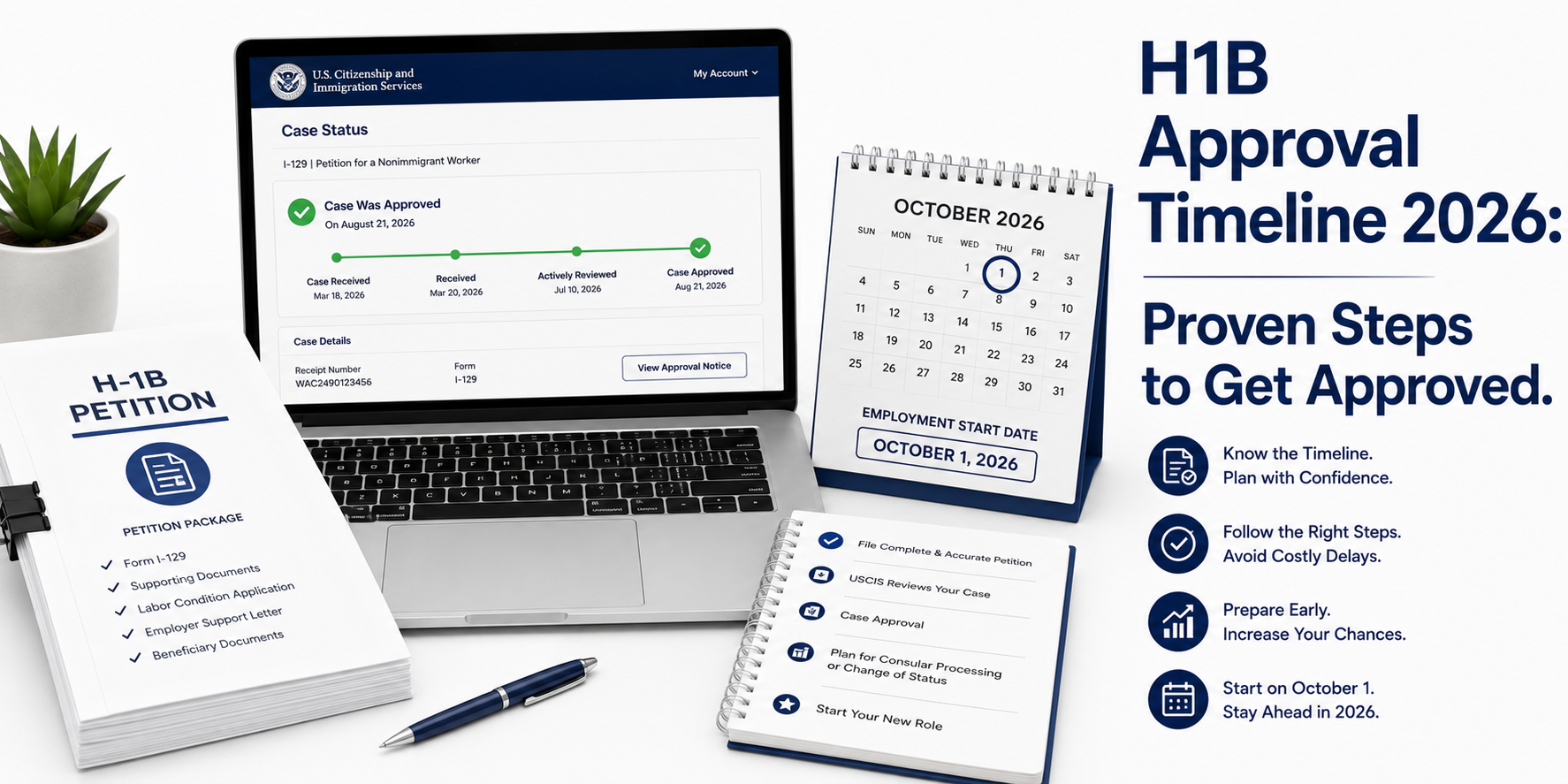
The H1B approval timeline is the first thing most people want to know after filing. How long will this take? When can I actually start working? What happens if something goes wrong?
This guide answers all of it. You get current processing times by service center, a step-by-step breakdown of every stage, what is making timelines longer in 2026 than they were two years ago, and what to do if USCIS sends an RFE.
Whether you are applying for the first time, an employer managing a hiring deadline, or an immigration professional advising clients, you will find what you need here.
H1B Approval Timeline: How Long Does It Actually Take in 2026
The honest answer is: it depends. It depends on which service center handles your petition and whether you pay for premium processing.
The Short Answer: Standard vs Premium Processing
Standard processing currently takes anywhere from 3 to 18 months depending on the service center and petition type. That range is wide, and where you land in it matters.
Premium processing costs an extra $2,805. In return, USCIS commits to giving you a decision within 15 calendar days. That decision could be an approval, a denial, or a Request for Evidence. Premium processing removes timeline uncertainty. It does not remove the risk of a bad outcome.
Why the H1B Approval Timeline Is Longer in 2026
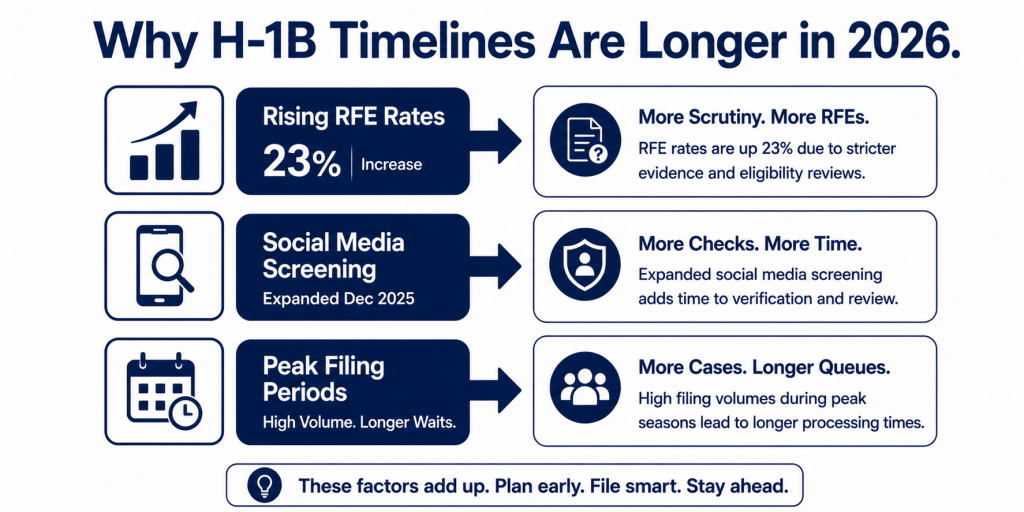
Three things changed between 2024 and 2026 that are making the H1B approval timeline longer.
First, RFE rates went up sharply. Build Talent Labs tracked a 23 percentage point jump in RFE rates in 2025 compared to 2024. USCIS officers are scrutinising specialty occupation classifications, employer-employee relationships, and degree qualifications much more closely than before. Every RFE adds months to the H1B approval timeline.
Second, the social media screening expansion that started in December 2025 for H-1B and H-4 applicants caused mass appointment cancellations at US consulates. Many applicants scheduled for December 2025 interviews were pushed to March 2026 or later. The consular stage is now longer than it used to be. Our article on H1B visas cancelled and what it means for applicants explains this in full.
Third, USCIS is handling roughly 780,000 H-1B applications per year under tighter scrutiny protocols. That volume plus stricter review means backlogs build faster.
How to Check Your Own Processing Time Right Now
USCIS publishes updated processing times every month. Go to uscis.gov/processing-times, pick Form I-129, choose your petition type, and select the service center from your receipt notice.
Your receipt number tells you which center has your case. WAC means California. EAC means Vermont. SRC means Texas.
Check it monthly. Numbers from three months ago may be completely different from today.
H-1B Approval Timeline by Petition Type
The H1B approval timeline is not the same for every petition. Here is what each type looks like.
New Cap-Subject H-1B Petition
This is the standard route for most first-time applicants. From lottery registration to the employment start date, the full H1B approval timeline is roughly seven months in the best case.
Registration opens in March. If selected, the employer has until June 30 to file the I-129 petition. USCIS standard processing then takes three to eight months depending on the service center. No matter when approval arrives, work cannot start before October 1.
Total from registration to work start: about seven months for cap-subject petitions.
Cap-Exempt H-1B Petition
Universities, nonprofits, and government research organisations can file H-1B petitions without going through the lottery. These can be filed and approved any time of year.
Standard processing runs three to six months. Premium processing cuts that to 15 calendar days. Because there is no October 1 restriction, the beneficiary can start work as soon as the petition is approved.
This is the fastest H-1B pathway available.
H-1B Transfer to a New Employer
When an H-1B holder changes jobs, the new employer files a transfer petition. The applicant can start working for the new employer as soon as the transfer is filed and the receipt notice arrives, as long as the previous H-1B was valid.
Standard processing for H-1B transfers runs three to six months. Premium brings it to 15 calendar days.
A real example: a transfer filed by Fragomen on May 14 at the Texas lockbox was received May 15, moved to active review May 16, and approved within six business days. Premium processing at its fastest can move very quickly. But that is not a guarantee.
H-1B Extension
Extensions can be filed up to six months before the current status expires. Standard processing runs four to ten months. If the extension is filed before the current status expires, the applicant gets an automatic 240-day work authorization extension while they wait.
Premium processing guarantees a 15-calendar-day decision. For someone actively employed, paying for premium processing to avoid a gap is almost always the right call.
H-1B After an RFE
When USCIS sends an RFE, processing pauses. The petitioner has up to 87 days to respond. Once USCIS gets the response, they pick up where they left off.
An RFE adds at least two to four months to the H1B approval timeline for standard processing. For premium processing, the 15-day clock restarts when the response is submitted. A fast, well-prepared response can still result in a quick resolution. A slow or incomplete one makes everything worse.
The Complete Cap-Subject H-1B Timeline: Step by Step
Here is the full cap-subject H1B approval timeline for the current FY2027 cycle, stage by stage.
Step 1: Lottery Registration (March)
The employer registers each applicant electronically through a USCIS online account during the March registration window. A fee applies per registrant.
For FY2027, USCIS confirmed on July 17, 2026 that the cap is filled. There will be no second lottery.
Step 2: Selection Notification (Late March)
Selected applicants get notified through their USCIS account. Only selected registrants can proceed to a full petition filing. Everyone else waits for the next cycle or explores a cap-exempt route.
Step 3: Labor Condition Application Certification (7 to 10 Days)
Before filing the I-129, the employer gets a certified Labor Condition Application from the Department of Labor. This confirms the employer will pay at least the prevailing wage for the role and location.
DOL typically certifies LCAs within seven to ten business days. The LCA must be posted at the worksite for ten days before the I-129 can go in.
Step 4: I-129 Petition Filing Window (April to June 30)
Selected employers have a 90-day window from lottery selection to file a complete I-129 petition. The FY2027 window ran from early April 2026 through June 30, 2026.
Ninety days sounds like a lot. With the LCA posting requirement and document assembly, the pressure is real.
Step 5: USCIS Processing (Standard or Premium)
Once the petition is filed, USCIS starts processing. Standard timelines vary by service center, covered in detail below. Premium processing guarantees a 15-calendar-day decision for $2,805.
Cap-subject petitions with an October 1 start date cannot authorise work before October 1, no matter when USCIS approves. Filing in April and getting approved in May still means an October 1 start. The early approval just removes the uncertainty.
Step 6: Employment Start Date (October 1)
October 1 is the earliest a cap-subject H-1B employee can start work. Under the ten-day rule, the beneficiary can enter the US up to ten days before the start date on the approved petition. For an October 1 start, that means the earliest US entry is September 21.
Standard Processing vs Premium Processing: Which One Do You Need
What Standard Processing Looks Like in 2026
Standard processing means USCIS works through petitions in the order they arrive, based on current workload. No extra fee. Current standard timelines run three to eight months for new petitions and four to ten months for extensions, depending on the service center.
What Premium Processing Actually Guarantees
Premium processing guarantees that USCIS will issue one of three decisions within 15 calendar days: an approval, a denial, or an RFE. USCIS meets that 15-day commitment in more than 98 percent of cases.
What Premium Processing Does NOT Guarantee
Premium processing does not guarantee approval. It does not stop an RFE from coming. It does not speed up the visa stamping stage at the consulate after USCIS approves the petition. It does not move an October 1 cap-subject start date earlier.
If an RFE arrives during premium processing, the 15-day clock restarts once the response is submitted. A petition that triggers an RFE can still drag on for months even with premium processing.
When Premium Processing Makes Sense
Pay for premium processing when a missed deadline has real consequences. An employment gap. A job offer that falls through if approval does not come in time. An expiring visa that cannot wait for standard processing.
Skip it when the start date is flexible, when a cap-subject October 1 date gives plenty of time, or when the budget does not justify it.
What Is Causing H-1B Delays in 2026
Rising RFE Rates and What Is Triggering Them
RFE rates jumped 23 percentage points in 2025 compared to 2024. USCIS is scrutinising three things more than ever: whether the job genuinely requires a bachelor’s degree in a specific field, whether the employer actually controls the worker’s day-to-day activities, and whether the applicant’s degree matches what the job requires.
Each of these can generate an RFE that adds months to the H1B approval timeline.
The Social Media Screening Expansion and Consular Delays
Starting December 15, 2025, every H-1B and H-4 consular interview includes mandatory social media screening. Each interview takes longer. Consulates process fewer people per day. The result was mass rescheduling, with many applicants pushed from December 2025 to March 2026 or later.
For applicants going through consular processing rather than a US-based change of status, the consular appointment backlog at high-volume posts like Chennai, Hyderabad, and Mumbai now adds four to eight weeks after USCIS approval.
Peak Filing Periods That Slow Everything Down
Three periods create backlogs every year. April and May bring the cap-subject petition surge. September is the year-end rush. December triggers an extension filing spike. Filing during these windows means entering a longer queue.
Site Visits and What They Do to Your Timeline
USCIS conducts unannounced site visits to verify petition details. When a case gets selected for a site visit, processing stops until investigators finish. Cases flagged for site visits can add weeks or months to the H1B approval timeline.
Service Center Workload Differences
Each service center manages its own workload and posts its own monthly processing time ranges. The same petition filed on the same day can take two months longer at one center than another, purely based on routing. You cannot choose your service center. It is assigned based on your employer’s address.
What Happens If USCIS Issues an RFE
How Much Time an RFE Adds
An RFE adds at least two to four months to a standard processing timeline. The petitioner has up to 87 days to respond. Premium processing restarts its 15-day clock once the response lands at USCIS. A fast, complete response under premium can still resolve quickly. A slow one extends the wait significantly.
The Most Common RFE Triggers in 2026
The three most common triggers are specialty occupation disputes, employer-employee relationship questions, and degree qualification mismatches. USCIS also sends RFEs for inconsistencies between documents, job location or duty changes not reflected in the filing, and insufficient evidence that the employer can pay the offered wage.
How to Respond Without Losing More Time
Respond as fast as you can. Speed does not hurt. It restarts the premium clock sooner and signals to USCIS that the petitioner is engaged.
Answer every single point in the RFE. An incomplete response is treated as partial compliance and can lead to denial. Work with an attorney to structure the response properly and include every document that addresses the stated concerns plus anything that preempts follow-up questions.
How to Avoid an RFE Before You File
Submit a complete and consistent petition the first time.
The job description should clearly explain why the role requires a specific degree. The employer-employee relationship should be documented with an org chart, employment contract, and evidence of supervisory control. The applicant’s degree should obviously match the role. Every document in the package should say the same thing.
If any of these areas are weak, USCIS will find them. Fixing them before filing is always faster than responding to an RFE after the fact.
H-1B Processing Times by USCIS Service Center
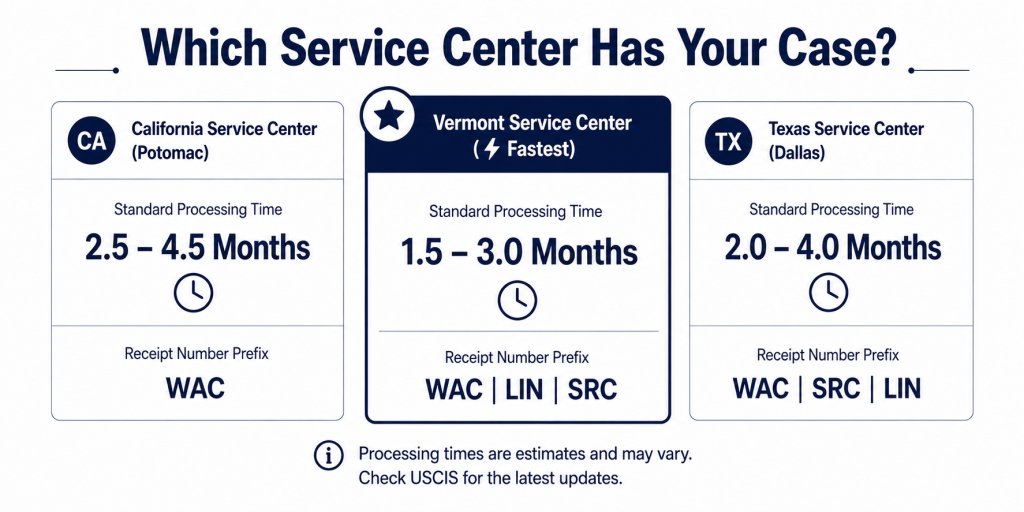
California Service Center
The California Service Center handles H-1B petitions involving consular processing, extensions, and certain employer-sponsored filings. It also handles other employment-based categories, which creates variability in its H-1B processing speed.
Current standard processing times range from 2.5 to 6 months for new petitions. Extensions run 5 to 6 months at the 80th percentile. Receipt numbers starting with WAC mean California has your case.
Vermont Service Center
Vermont handles the largest share of US employer H-1B filings, roughly 28 percent of all H-1B cases nationally. It currently processes cases faster than California for most standard petition types.
New petitions run 4 to 6 months, with 80 percent of cases done within 4.5 months. Extensions and amendments typically run 3 to 4.5 months. Receipt numbers starting with EAC mean Vermont has your case.
Texas Service Center
Texas commonly handles change-of-status requests, extension filings, and transfer petitions. It manages about 21 percent of H-1B cases nationally. Receipt numbers starting with SRC mean Texas has your case.
Standard processing at Texas is broadly comparable to California. Check the USCIS processing times tool monthly for current ranges since they change frequently.
How to Track Your Case in Real Time
Go to uscis.gov/casestatus and enter your receipt number. You can also set up email or text alerts for status changes.
If your petition was filed on or before the Service Request Date shown for your service center and you have not heard anything, you can submit a service request through your USCIS online account.
The Ten-Day Rule and What It Means for Your Start Date
What the Ten-Day Rule Actually Says
H-1B beneficiaries can enter the US up to ten days before the employment start date on their approved petition. They can also stay up to ten days after their authorised period ends.
If the approved petition says October 1, the earliest entry date is September 21.
Why Filing Early Does Not Move Your Start Date Forward
Getting approved in January for an October 1 start date does not let you start in January. The start date on the petition controls when work begins. Not the approval date.
What early approval gives you is peace of mind. You know the petition is done. You can plan around October 1 without worrying whether USCIS will finish in time.
What Happens If Approval Comes After October 1
If USCIS approves a cap-subject petition after October 1 and the petition lists October 1 as the start date, the beneficiary can start immediately upon receiving the approval. The October 1 date has already passed, so there is no further wait.
If the petition lists a future start date that has not arrived yet, the beneficiary waits for that date.
How to Shorten Your H-1B Approval Timeline
File as Early as Possible
For cap-subject petitions, file the moment the April window opens. Earlier submissions enter the queue first. This does not move the October 1 start date but it gives extra buffer if an RFE arrives or processing runs long.
For extensions, cap-exempt, and transfer petitions, file as early as the regulations allow. Extensions can go in up to six months before the current status expires.
Use Premium Processing When It Matters
If a delay would cost your client a job offer, cause an employment gap, or let a visa expire before approval arrives, $2,805 for premium processing is worth it. The certainty of a 15-day decision is more valuable than the fee when the stakes are real.
File Clean the First Time
The fastest path through the H1B approval timeline is a petition that USCIS approves without asking a single question.
That means a job description that clearly justifies specialty occupation, an org chart that shows who the person reports to, credentials that obviously match the role, and financial documents that confirm the employer can cover the salary. Every document in the package should be consistent with every other document.
One weak area is all USCIS needs to issue an RFE. And an RFE adds months.
How VizaCheck Helps Agents Avoid RFEs Entirely
Immigration professionals who use VizaCheck to review H-1B applications before submission know exactly what they are filing. Not hoping. Knowing.
VizaCheck’s Application Consistency Engine checks every document for contradictions, flags mismatches between the application and the applicant’s public professional profiles, and applies country-specific scrutiny logic to find the issues most likely to generate an RFE. The Social Media Risk Intelligence layer checks that what is publicly visible about the applicant matches what the petition says, which matters especially now that H-1B consular interviews include mandatory social media screening. The Document Intelligence layer reviews financial records and employment documentation for gaps that raise questions.
With RFE rates up 23 percentage points year over year, filing a petition that has been reviewed across every risk layer is not extra caution. It is the difference between a three-month H1B approval timeline and a six-month one.
Ask your immigration consultant or attorney whether they use VizaCheck before filing.
Learn how VizaCheck helps immigration professionals file with confidence
Processing times change every month. Come back here for updated H-1B processing time data and what it means for your case right now.
What are the latest updates on the H-1B visa for 2026?
Several things changed in 2026 that directly affect the H-1B approval timeline. USCIS confirmed on July 17, 2026 that the FY2027 H-1B cap has been filled and there will be no second lottery drawing. The social media screening expansion that started in December 2025 for H-1B and H-4 applicants is now fully in effect, and it has caused consular appointment delays of up to several months at high-volume posts. RFE rates also jumped 23 percentage points in 2025 compared to 2024, meaning more petitions are being questioned before approval. The premium processing fee currently stands at $2,805 for a guaranteed 15-calendar-day decision.
What is the expected H-1B visa approval rate in 2026?
Once a petition clears the lottery and reaches the adjudication stage, the overall H-1B approval rate remains strong at around 97 to 98 percent based on the most recent USCIS data. In FY2025, USCIS adjudicated 415,275 H-1B petitions and approved 406,349 of them, a rate of 97.9 percent. However, that number is not the same for every employer type. Petitions filed by direct-hire employers with clean compliance records consistently exceed 90 percent approval. Petitions from third-party staffing firms dropped to around 68 percent in the same period. The approval rate is not one fixed number. It depends heavily on the strength of the petition, the employer’s profile, and the service center handling the case.
How many days will it take to get an H-1B approval notice?
It depends on whether you use premium or standard processing. With premium processing, USCIS commits to a decision within 15 calendar days of receiving the request, for an additional fee of $2,805. That decision could be an approval, a denial, or an RFE. With standard processing, timelines currently range from 3 to 8 months for new petitions and 4 to 10 months for extensions, depending on which service center handles your case. Vermont Service Center is currently the fastest, completing 80 percent of cases within 4.5 months. California Service Center runs slightly longer at 5 to 6 months for the same 80th percentile. If an RFE is issued, the clock pauses and resets, adding at least two to four months to the total timeline.
How many H-1B applications are selected for 2026?
For FY2027, which covers the 2026 filing cycle, USCIS selected approximately 110,000 registrations from a pool of roughly 759,000 eligible registrations. That is an initial selection rate of around 14 percent. The congressionally mandated annual cap is 65,000 visas for the regular cap and an additional 20,000 for applicants with a US advanced degree, totalling 85,000. USCIS confirmed on July 17, 2026 that the FY2027 cap has now been met and no second lottery will take place. The lottery uses a beneficiary-centric selection process, which means multiple registrations filed for the same person are treated as one entry to prevent employers from gaming the system.
What happens to my H-1B if my employer goes out of business before my approval?
If your employer closes or shuts down before USCIS approves your petition, the petition is effectively withdrawn because there is no longer a valid employer-employee relationship to support it. USCIS will deny or revoke the petition if it becomes aware of the closure. If the shutdown happens after approval but before your start date, you face a similar problem since the basis for the visa no longer exists. In either scenario, you have limited time to find a new sponsoring employer who can file a new petition on your behalf. If you are already in valid H-1B status from a previous employer, the 60-day grace period may apply, giving you time to secure a transfer. Acting quickly and working with an immigration professional as soon as you learn of a potential closure is critical.