An AI visa screening tool is now the difference between an immigration professional who prevents refusals and one who keeps explaining them to clients.
They fail because of things nobody thought to check. A LinkedIn profile that says one job title while the petition says another. A bank statement that does not add up. A social media post from three years ago that a consular officer flags before the client even sits down for the interview.
These are not unusual situations. They happen every week, to clients of good immigration professionals who are doing exactly what they have always done. The problem is that what they have always done is no longer enough.
VizaCheck was built for this moment.
Table of Contents
The World Changed. Most Agents Have Not
Getting a visa used to be about paperwork. You gathered the documents, filled in the forms, and submitted. The embassy matched everything against their checklist. If it all lined up, you got approved.
That process still happens. But it now sits inside a system that checks a lot more than paperwork.
What Embassies Now Check That They Did Not Before
Starting in June 2025, the US Department of State began rolling out mandatory social media screening across all major visa categories. Students and exchange visitors came first in June 2025. H-1B workers and their dependents were added in December 2025. Then on March 30, 2026, the State Department announced its biggest expansion yet, bringing over a dozen more non-immigrant visa categories under mandatory online presence review.
The official position from the State Department is direct: every visa decision is a national security decision. Officers are now expected to use all available information during vetting. That includes social media.
The results have been real and they have been serious.
In 2025 alone, the US State Department revoked over 6,000 international student visas. Around 4,000 were linked to alleged law violations, but many cases had nothing to do with criminal activity. Students lost their visas over social media posts. Some lost them simply for liking or sharing posts online.
One of the most widely covered cases involved Rümeysa Öztürk, a doctoral student at Tufts University. She was detained in March 2025. The only reason the Department of Homeland Security gave was that she had co-written a student newspaper opinion piece criticising how the university responded to student resolutions about Palestine. A federal judge later ruled it was not a valid basis for detention.
In a separate case, a Norwegian traveller was turned away at the US border after officers found a political meme about a senior US official on his phone.
The State Department also ran a programme called “Catch and Revoke.” It used AI tools to scan tens of thousands of visa holders’ social media accounts for political activity or content considered hostile to US foreign policy. Revocations followed.
For Nigerian applicants, the warning came directly from the US Mission in Nigeria. In August 2025, the Mission posted on its official X account that Nigerian visa applicants must now disclose every social media handle they have used in the past five years on the DS-160 form. The message was unambiguous: leave one out and you risk denial. Get denied for omitting information and you could lose eligibility for future US visas permanently.
A former Nigerian career diplomat went further in public comments, warning that anything posted in a comment section, even years earlier, could come up during vetting. The Nigerian government responded by signalling it would apply the same rules to US applicants seeking Nigerian visas.
For immigration professionals handling Nigerian clients, this is not a background detail. An old comment, a reshared post, a forgotten username left off a form. Any one of these can end a client’s visa application. And when that happens, it costs the agent too.
This is now the environment. Officers routinely assess:
- Social media history and online behavior
- Whether what a client says online matches what they declared on the form
- Financial patterns from bank statements
- Consistency across every document in the application
- Credibility signals that go far beyond any single piece of paper
Documents matter. But documents alone are not enough anymore.
Why Manual Checks Cannot Keep Up
Most immigration professionals still run manual checks. Review the documents. Cross-reference the key details. Submit. It worked fine when embassies were only reading paperwork.
The problem is that no agent has the time to properly cross-check a client’s full social media history against their application, look at bank statement patterns for credibility signals, and make sure every document in the package is saying the same thing, all before the submission deadline.
The numbers show what happens when that gap is not closed. Indian F-1 visa refusals hit 61 percent in 2025, the highest in a decade. F-1 approvals between June and July 2025 dropped 69 percent compared to the same months in 2024. Not all of that is social media. But the timing is not a coincidence.
Avoidable refusals. Lost revenue. Damaged reputation. Not because agents are careless. Because the tools they have were built for a different era.
What an AI Visa Screening Tool Actually Does
Visa screening software reviews a visa application across multiple risk areas before it is submitted. It finds the problems most likely to cause a refusal and gives the agent the information they need to fix them before anything goes to the embassy.
It is not a document storage tool. It is not a form assistant. It is not a case management system.
It is a pre-submission risk check. The work happens before the application reaches any official.
The Old Way and the VizaCheck Way
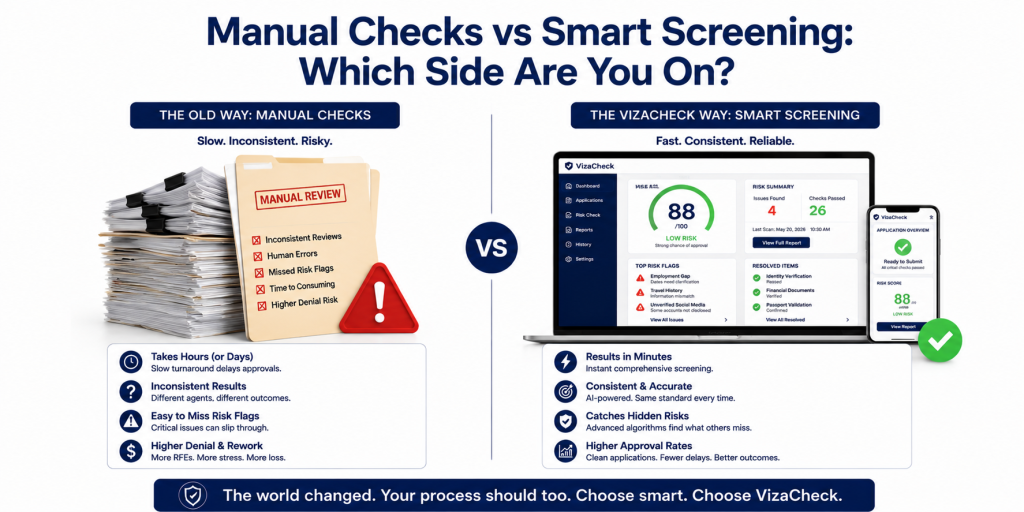
The old way: gather documents, do a quick check, submit, wait, hope. If a refusal comes back, figure out what went wrong and start over.
The VizaCheck way: before submission, the application goes through an AI-powered scan. The agent gets a risk score. They see which issues are most likely to cause a problem. They fix them. Then they file.
That shift from reactive to predictive is what changes the quality of the service an immigration professional can offer.
What This Looks Like for an Agent
Before filing, the agent knows what the embassy is likely to find. They know which social media posts could raise questions. They know where the documents contradict each other. They know which financial patterns may need explaining.
They can advise the client on what to address, make the corrections, and file something clean. Not just complete. Clean, consistent, and credible.
That is what VizaCheck makes possible.
How VizaCheck Works: The Three Intelligence Layers
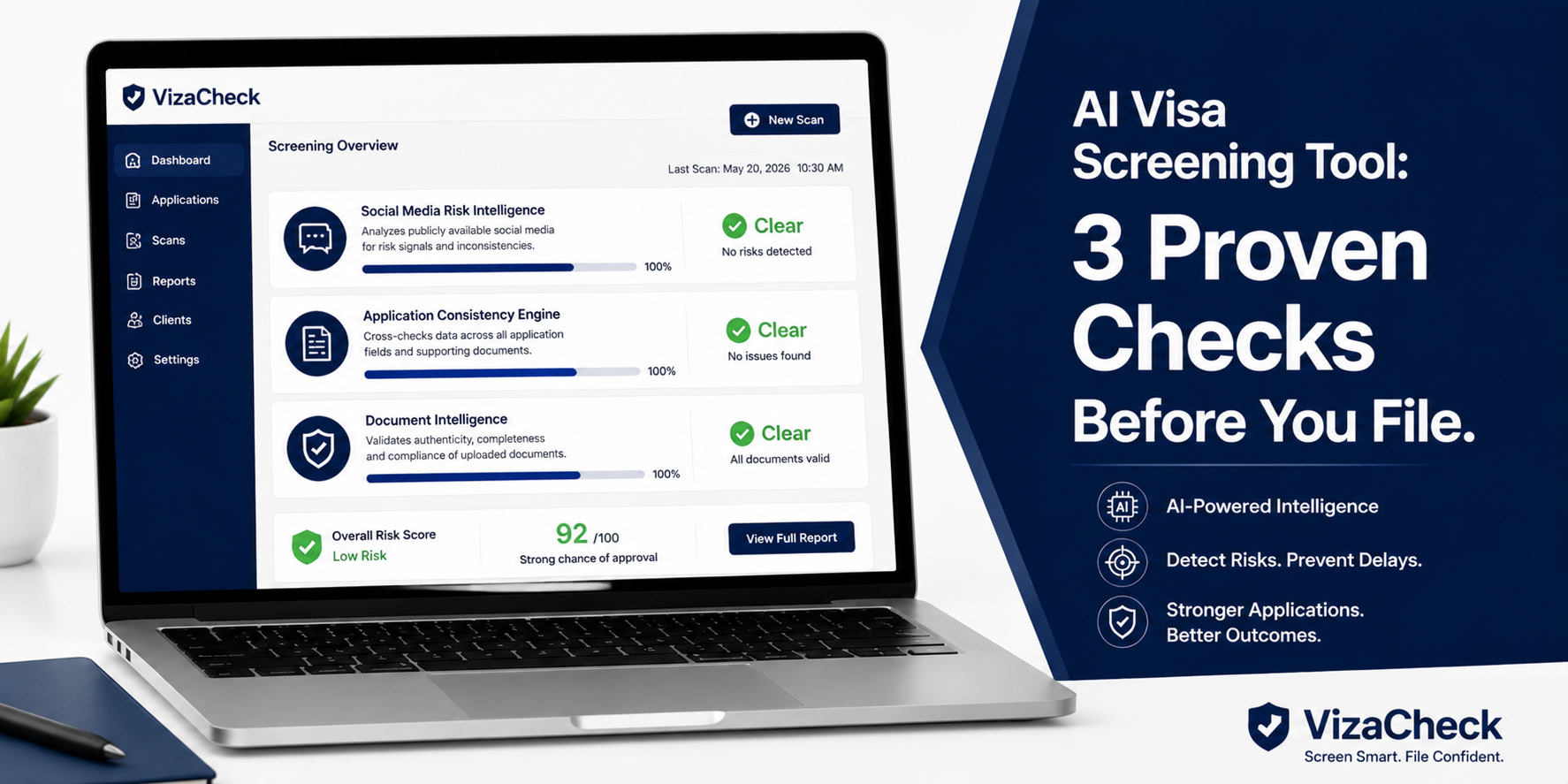
VizaCheck scans applications across three layers. Each one catches different risks.
Social Media Risk Intelligence
This layer looks at what the client has posted publicly online and compares it to what they declared on their application.
It picks up content that embassies flag, catches lifestyle details that do not match the declared information, and surfaces behavioral signals that could affect how a consular officer reads the case.
Problems that would have come as a surprise at the interview stage show up here, before submission, when there is still time to do something about them.
For a full breakdown of what consular officers check during the social media review process, read our guide on US visa social media screening.
Application Consistency Engine
This layer goes through the visa forms and checks them for contradictions. Employment history, travel record, education background. Every detail is checked across every document.
It also applies country-specific logic, built around the scrutiny patterns that apply to applicants from different nationalities.
The result is an application where every document is telling the same story, with no gaps for an officer to question.
Document Intelligence
This is the deepest layer. It goes into the supporting documents, not just the forms.
It looks at bank statement patterns and checks whether the spending behavior matches what the client has declared. It verifies employment details and company information. It identifies inconsistencies in financial documentation that can trigger a deeper review.
The result is an application that does not just state the right things. It shows them.
What the VizaCheck Report Looks Like
Every scan produces a report. The agent receives it within five to twenty-five minutes. It has three parts.
A risk score. A number out of one hundred that tells the agent how strong the application is and where the risks are concentrated.
A red flag list. A ranked list of the specific issues most likely to cause a refusal, ordered by how serious each one is.
Remediation steps. For every red flag, a specific action. Not vague guidance. Exact steps the agent can take to fix each issue before filing.
The agent does not just find out what is wrong. They find out what to do about it.
What VizaCheck Partners Gain
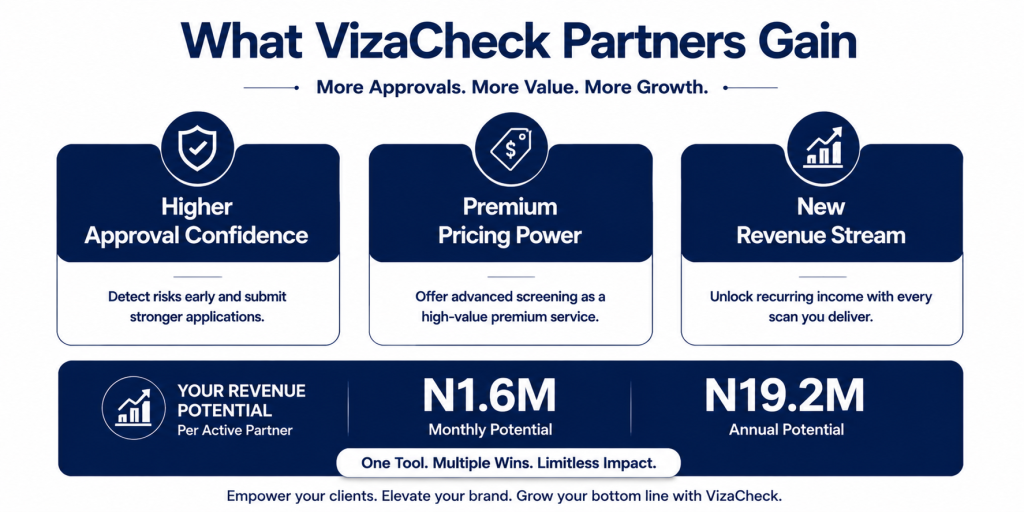
Immigration professionals who use VizaCheck do not do it because it sounds modern. They do it because it changes what they can deliver.
Higher Approval Confidence
They file knowing the risks have been found and addressed. The guesswork stops.
Premium Pricing Power
There is a real difference between an agent who hands over a document package and one who delivers a risk-scored, reviewed application with a detailed report. The second one justifies a higher fee. Intelligence-backed services command better rates than document processing.
A New Revenue Stream
VizaCheck runs on a simple platform fee model. No upfront cost. No subscription. No operational overhead.
The partner sets their own client-facing price and keeps one hundred percent of the markup. At twenty clients a month, that works out to roughly N1.6 million in monthly revenue and N19.2 million a year, without changing the core service.
The pricing has three tiers. Basic at N100,000 covers straightforward applications. Full Analysis at N120,000 provides the complete multi-layer review. Premium at N175,000 is for complex cases that need deep document intelligence and advanced fraud detection. Markup is allowed up to N200,000 per client.
Who VizaCheck Is Built For
VizaCheck is for immigration professionals who are already handling applications regularly and want to do it at a higher level.
Immigration consultants who manage client visa portfolios and want better results and a stronger market position.
Travel agencies that include visa assistance in their packages and want fewer refusals damaging client relationships.
Visa processing firms handling high volumes where even a small improvement in outcomes adds up fast.
Immigration lawyers who want data to support their case preparation and fewer Requests for Evidence slowing down their clients.
If you work with H-1B clients and want to understand what they are currently navigating, our article on H1B visas cancelled covers the 2026 appointment cancellations and what they mean in practice.
How to Get Started as a VizaCheck Partner
Five steps. No technical setup needed.
Step 1: Register. Create your partner account on the VizaCheck dashboard in minutes.
Step 2: Complete onboarding. A guided process walks you through every feature before you use it with a client.
Step 3: Invite your first client. Send the invitation from the dashboard. The client submits their own information.
Step 4: The scan runs. VizaCheck processes the application across all three layers in five to twenty-five minutes.
Step 5: Get the report and guide your client. Share the findings, address the issues, and file with confidence.
Revenue starts from the first client.
The visa system is stricter than it has ever been. Embassies are checking more, scrutinising more, and refusing applications that would have gone through without a second look five years ago.
The professionals who recognise this and adapt will build stronger businesses. The ones who keep doing what they have always done will keep absorbing refusals they could have prevented.
VizaCheck is how you adapt.
Explore the VizaCheck partner programme
What exactly does visa screening software do?
It checks a visa application for problems before it goes to the embassy. Most refusals happen because of things that could have been caught earlier, a social media post that contradicts the application, a bank statement that does not add up, a document that tells a different story from the form. Visa screening software runs those checks automatically and tells you exactly what needs to be fixed before you file.
Is visa screening software only useful for complicated cases?
Not at all. Even straightforward applications can have hidden issues that only show up when you look across the full picture. A client with a clean record can still have an old LinkedIn profile that contradicts their petition, or a forgotten social media handle they did not disclose. The simpler the case looks, the easier it is to miss something. Running a pre-submission scan on every case is what separates agents who rarely get refusals from those who treat them as inevitable.
How is VizaCheck different from just reviewing documents manually?
Manual review checks what you can see. VizaCheck checks what you might not think to look for. It cross-references your client’s social media presence against their application details, analyses financial patterns in their bank statements, and checks every document for internal contradictions. It does this in five to twenty-five minutes and gives you a ranked list of the issues most likely to cause a refusal, along with specific steps to fix each one. No manual process can cover that ground consistently and quickly enough to make a real difference at scale.
Will using VizaCheck slow down my workflow?
It actually speeds it up. Instead of submitting and waiting to find out what went wrong, you get a full risk report before you file. You fix the issues. You file once. No back and forth, no request for evidence delays, no refusal to explain to a client. The scan itself takes five to twenty-five minutes, which is a small investment compared to the time and reputation cost of handling a refusal after the fact.
Do I need technical skills to use VizaCheck as a partner?
No. The platform was built for immigration professionals, not developers. You register, complete a short onboarding process, invite your client from the dashboard, and the AI does the rest. The report comes to you in plain language with clear action steps. You do not need to understand the technology to use it well. You just need to know how to read the report and advise your client accordingly, which is exactly what you are already trained to do.