You fill out your visa form. You add your documents. Then you submit everything.
But what happens next?
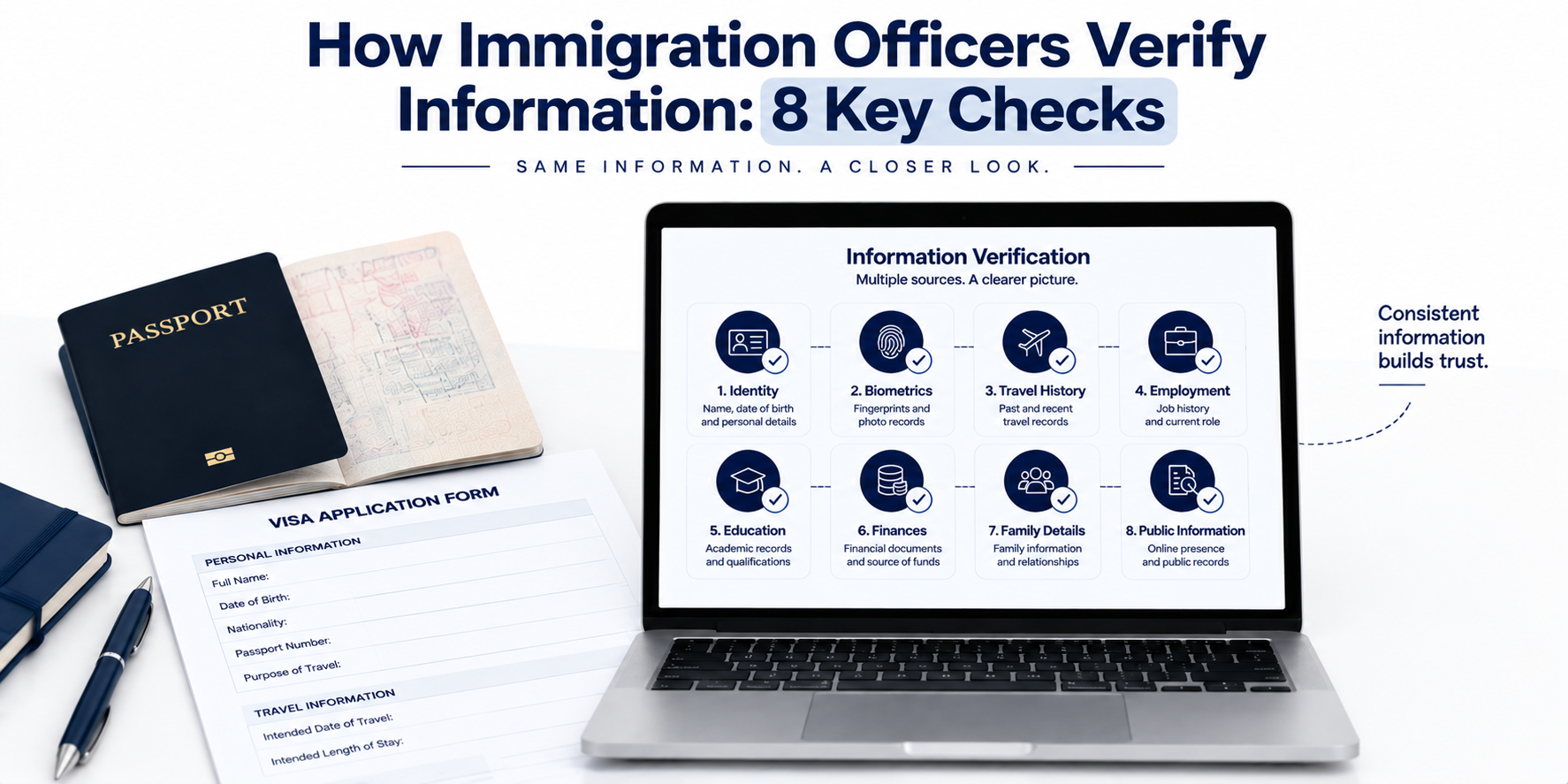
Immigration officers do more than read what you send. They may compare your form with your passport, past applications, travel records, bank statements and other records. They may also check your answers during an interview.
This is how immigration officers verify information. They look for facts that match. They also look for gaps or details that do not make sense.
This does not mean every person gets every check. The checks depend on the country, visa type and facts in the application.
This guide explains the visa application background check in simple terms. It also shows you what to review before you apply.
How Immigration Officers Verify Information: The Short Answer
Immigration officers compare the facts in your form with other proof. This can include the documents you send, old visa records, travel records, public information and your interview answers.
They often want to confirm three things:
- You are who you say you are.
- You meet the visa rules.
- Your story is true and makes sense.
Information Supplied in the Application
Your form is the first place an officer looks. It may include your name, passport number, home address, job, school, family, money, travel plans and past visa history.
The officer may compare answers within the same form. If you give one job start date in one section and a different date in another, that gap can be found without any outside check.
Records Held by Immigration and Border Authorities
An immigration office may already have information from your past dealings with it. This may include old visa forms, refusals, permits, border entries and biometric records.
An old answer may still matter. Do not guess what you wrote before. Keep copies of every form and document you submit.
Supporting Evidence and Third-Party Records
Your documents support the facts in your form. They may include your passport, bank statements, job letters, school records, birth certificate or marriage certificate.
An officer may check a document’s marks, number or source. In some cases, the office may ask the group that issued it to confirm it.
This does not mean every bank, school or employer gets a call. The steps used depend on the case.
Interviews, Biometrics and Security Screening
During an interview, the officer can compare your spoken answers with your form and documents.
Biometrics are body details used to confirm who you are. They may include your fingerprints and photo. Some countries use them for identity and security checks.
In April 2026, USCIS widened the criminal record details used for some US fingerprint checks. The change covered some cases, such as permanent residence and citizenship. It did not apply to every visa in every country (Reuters).
| What may be checked | What it may be compared with | What you should review |
| Your identity | Passport, birth record and biometrics | Name, birth date and document numbers |
| Your job | Job letters, work records and public profiles | Employer, role, pay and dates |
| Your money | Bank statements and sponsor records | Income, large deposits and account name |
| Your travel | Old applications and entry records | Trips, refusals and visa history |
| Your family ties | Civil records and interview answers | Names, dates, homes and shared history |
Who Checks Your Visa or Immigration Application?
People often call every official an immigration officer. But each official has a different job. This matters when we explain how immigration officers verify information.
Consular Visa Officers
Consular officers often review visa applications made from outside the country you want to visit.
They may check your form, documents, visa history, security results and interview answers. What they need to see depends on the visa. A visitor, student, worker and spouse do not need to prove the same things.
Immigration Case Officers
Immigration case officers may review work permits, visa extensions, residence cases, family cases and citizenship requests.
For example, USCIS handles many immigration cases in the United States. IRCC handles visa and immigration cases for Canada. Each office follows its own laws and rules.
Border and Entry Officers
A valid visa may let you travel to a border. It does not always mean you must be allowed in.
A border officer may check your passport and visa. The officer may also ask why you came, where you will stay and how long you plan to remain. Your answers should still match the reason given in your visa application.
Automated Systems and Human Reviewers
Some immigration offices use computer systems to match records, check identity or flag details for review.
But a computer flag is not always a refusal. It may only mean that a human officer needs to look more closely.
Governments do not share every rule used in automated visa screening. Be careful with websites that claim to know every “secret” visa check.
What Information Can Immigration Officers Check?
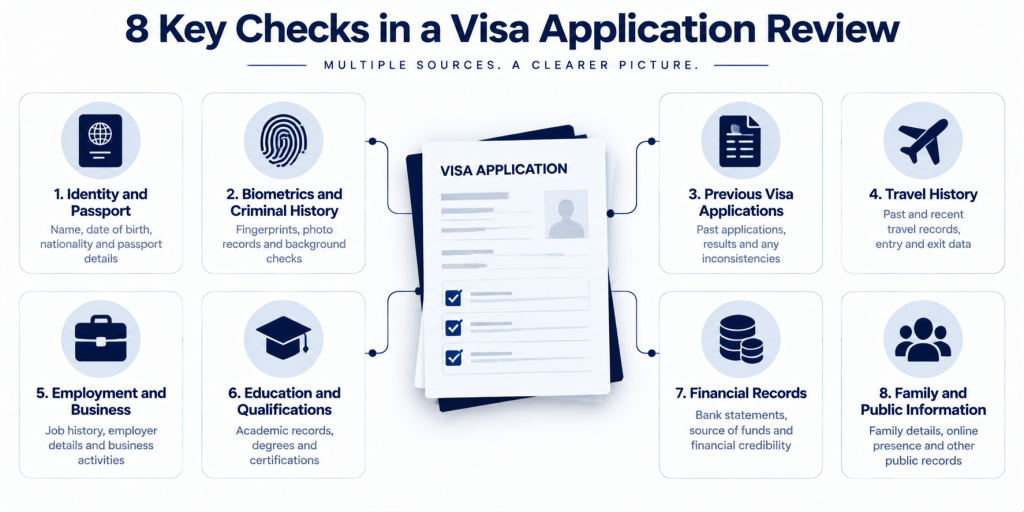
What an officer can check depends on the law and type of application. Still, the areas below often matter in a visa application background check.
Identity and Passport Information
The officer can check whether the name, photo, birth date and passport details in your form match your passport.
A missing middle name or a different spelling may have a simple cause. But you should explain any real name gap and add the right proof when needed.
Biometrics and Criminal-History Records
Some applicants must give fingerprints and a photo. These can help the office confirm identity and carry out legal security checks.
The records checked will not be the same in every country. Answer all crime and security questions truthfully. Do not assume an old record will stay hidden.
Previous Visa Applications and Refusals
An officer may compare your new form with an old one. They may look at your past jobs, schools, homes, family details, travel plans and refusals.
Life changes. You can move, marry or get a new job. A change is not a problem by itself. The dates and facts should simply make sense.
Travel, Entry and Exit History
Your passports, visas, stamps and government travel records can show where you have been.
Check your old passports before you complete the travel section. Do not leave out a trip because it appears in an expired passport.
Employment and Business Information
Job details may be compared with job letters, payslips, contracts, tax records or business records.
The officer may check the name of your employer, your role, your pay and your work dates. This is why your form, CV and job letter should tell the same clear story.
Education and Professional Qualifications
The officer may review your degree, school record, licence or work membership.
Check the school name, course, dates and award across every document. Follow the rules for your visa. Some routes ask for a special review of foreign school records.
Financial Records and Proof of Funds
Your money records may show that you can pay for your trip, school or living costs.
An officer may check who owns the account. They may also look at whether the money fits your job, income and story.
This is part of visa document verification. A bank statement should support your case, not raise more questions.
Family Relationships and Sponsorship Details
Family cases may use birth records, marriage records, photos, shared bills, messages and interview answers.
No single photo can prove a full relationship. The officer looks at the whole case. Small memory gaps do not always mean fraud. But large gaps about key facts may lead to more questions.
Social Media and Other Public Information
Some visa processes ask for social media details. Officers may also be able to see public job profiles, business pages and other open information.
Do immigration officers check social media in every case? No. The level of checking depends on the country and visa process.
Still, public details should not clash with your form. Your goal is not to create a fake perfect profile. Your goal is to give true and clear information.
How Do Visa Officers Verify Supporting Documents?
Visa document verification does not always mean that every page gets the same check.
The officer may focus on the documents that prove your identity, money, job, school or reason for travel.
Document Completeness and Internal Consistency
First, the officer may check if the document is complete, clear, current and signed where needed.
They may also compare it with your form. If your job letter shows one salary but your form shows another, the gap may need an answer.
Authenticity Features and Issuing Authorities
Real records may have seals, numbers, security marks or online checks. In some cases, the office may check with the group that issued the record.
Never edit a real document yourself. Ask the issuer to fix it or use the correct way to explain the error.
Employer, School or Sponsor Verification
An officer may ask for more proof from your employer, school or sponsor. Direct contact may happen in some cases, but not all.
Tell a real employer or sponsor that they may need to answer a legal check. Do not teach them to give false answers.
Translations, Certifications and Document Formats
A real document can still fail the rules if it is hard to read or sent in the wrong form.
You may need a proper translation. A file may also need to meet a size rule. A copy should show the full page.
Use the official checklist for your visa. A rule for another country may not apply to you.
When Additional Evidence May Be Requested
The office may ask for another document or a clear answer if the first proof is not enough.
In some US cases, this may be called a Request for Evidence. Other countries may use a different name.
Read the request with care. Answer the real question and meet the deadline. Do not send many pages that do not solve the problem.
Do Immigration Officers Check Bank Statements?
Yes. Bank statements may be checked when money is part of the visa rules. But the officer will often look at the statement as part of your full story.
What Financial Evidence Is Intended to Prove
Money records may show that you can pay for travel, tuition or living costs. They may also show that a sponsor can support you.
The right amount and time period depend on the visa. Always check the current official rule.
Income and Employment Consistency
Your income should make sense when compared with your job and bank activity.
A gap does not always mean fraud. But you may need to explain where the money came from.
Sudden Deposits and Unexplained Transactions
Think of a person who earns $1,500 each month. One week before applying, $20,000 enters the account.
The money may be real. But the statement does not show where it came from.
If it came from a house sale, gift or investment, add the right proof. Do not borrow money for a short time and call it savings.
Sponsor Funds and Account Ownership
If another person will pay for you, you may need to show who they are and how they know you.
You may also need proof that they own the money and can support you. Check the names, dates and account details. Make sure the sponsor’s story matches yours.
Why Applicants Should Not Use Fabricated Financial Evidence
Never use a fake or edited bank statement. False proof can lead to refusal and other serious visa problems.
If you do not meet the money rule, look for a legal choice or speak with a trained visa adviser. A false record is not a safe fix.
Do Immigration Officers Check Social Media?
They can in some visa and immigration cases.
Some forms ask for social media names. Public posts and profiles may also help support or question what an applicant says. However, this does not mean every post is read in every case.
Public Profiles and Disclosed Identifiers
If the form asks for your social media names, answer as required.
Do not give a fake name. Do not hide an account that the form tells you to list. Read the form and official guide to know what you must share.
LinkedIn Employment and Education History
LinkedIn can cause simple visa application inconsistencies.
You may forget to end an old job. You may also use short dates that do not match your job letter.
For example, your form may say you started work in January 2021. Your CV says March. LinkedIn says June.
Maybe you were an intern in January, a contract worker in March and a full worker in June. Use the date the form asks for. Explain the steps when needed.
Posts That Conflict With the Purpose of Travel
A public post may cause questions if it goes against the reason you gave for travel.
For example, a visitor says the trip is for a short holiday. But a public post says the person plans to start a new job after arrival without the right work visa. The two stories do not match.
What Applicants Should and Should Not Do Before Applying
Check your public profile for wrong or old facts. Update your real job or school details when needed.
Do not lie, make a fake page or hide details that the form asks for. Deleting a post may not remove every old copy.
If a post may cause a serious legal issue, speak with a trained immigration lawyer or adviser.
You can also learn how to use an AI visa screening tool before filing. It may help you find gaps across your form, documents and public details.
Can Immigration Officers See Previous Applications?
They may be able to see past applications held in their immigration system. The rules for keeping and sharing records are different in each country.
Why Previous Answers Still Matter
An old form is part of your visa history. This is true even if an agent filled it out for you. You may have signed or agreed that the answers were true.
Always ask for a copy of every form sent in your name.
Common Conflicts Between Old and New Applications
Common gaps include old job dates, home addresses, family details, travel history and past refusals.
Some details change over time. That is normal. Add the correct dates so the change is easy to understand.
Previous Refusals and Immigration Violations
Answer questions about refusals, long stays, removal and other visa issues with care.
Read the exact question. It may ask about one country or every country. Do not leave out a refusal because you think it is too old to matter.
What to Do When an Earlier Application Contained an Error
Do not repeat an old error just to make both forms match.
Find the true fact. Keep proof. Then use the proper way to fix or explain it.
Get legal help if the error is important or may be seen as false information.
How Automated Visa Screening Works
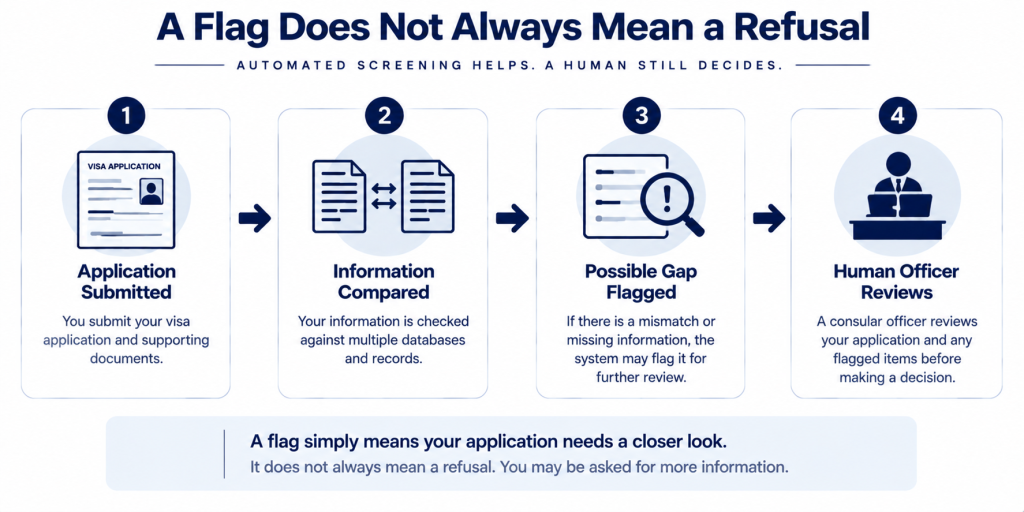
Automated visa screening can help an office review a large number of records. But no public guide shows every check used by every country.
Identity Matching and Biometric Checks
A computer system may compare your name, photo or fingerprints with other records. This can help the office confirm who you are and find records linked to you.
Database and Record Comparisons
A system may compare form details with visa history, travel data or other legal records. The information it can use depends on the law and the office.
Do not try to beat the system. Give true facts and check them before you submit.
Automated Flags Versus Final Decisions
A mismatch does not always prove fraud. Two people may have the same name. An old record may be wrong. A real life change may also explain the gap.
Automated visa screening may flag the case. A human officer may then need to review it.
What Immigration Authorities Do Not Publicly Disclose
Governments do not share all their security rules, tools or warning signs. Be careful with anyone who claims to know the full secret system.
VizaCheck reviews the information that you control. It does not enter private government systems. It also does not promise approval.
What Happens When Officers Find Inconsistent Information?
The result depends on the size of the gap and why it matters. A small typo is not the same as a fake job letter.
Requests for Clarification or Additional Documents
The office may ask you to explain a gap or send more proof.
Give a short and clear answer. Show the right fact and the proof behind it.
Interviews and Administrative Processing
The officer may ask about the issue in an interview. The case may also need more checks. This can add time to the process.
Answer only what is asked. Do not make up details. It is better to say you do not remember than to give a false answer.
Delays and Possible Refusal
A gap that is not cleared up may delay the case. It may also lead to refusal if you do not prove that you meet the visa rules.
Learn more about common reasons for visa denial before you submit.
Honest Mistakes Versus Material Misrepresentation
An honest typo is not always fraud.
But an error can still matter if it changes whether you qualify. Hiding a refusal or using a fake job letter is far more serious than spelling a street name wrong.
Fix key errors through the proper channel. Get legal help if the issue may be seen as false information.
Examples of Visa Application Inconsistencies
The examples below show how common gaps may come up during visa document verification. They do not tell us how a real officer will decide a real case.
Different Employment Dates Across Documents
Ada says she joined a company in January. Her job letter says March. LinkedIn says June.
The true story is that she became an intern in January, got a contract in March and became a full worker in June.
Ada should use the date asked for on the form. She should explain the work stages if needed.
An Unexplained Deposit Before Submission
Kunle gets a large payment just before his student visa application. His salary does not explain it.
The money came from his parent. He should show the right sponsor papers and source of funds. He should not call the money his own savings.
A Relative Omitted From a New Application
An old form lists the applicant’s sister in the country. The new form says there are no family members there.
The applicant may have read the question in the wrong way. The right step is to check the old form and answer the new one truthfully.
An Outdated LinkedIn Profile
Maya left her old job six months ago. LinkedIn still says she works there. Her visa form lists her new job.
She should update the old public detail. If asked, she can explain that the page was out of date.
Travel History Missing From an Old Passport
An applicant lists trips from a current passport but forgets trips in an old one.
Old passports, emails and tickets can help build a full travel list.
Name Differences Across Official Records
A school record leaves out a middle name shown in the passport.
The applicant may need another record or a clear note to show that both papers belong to the same person. The right proof depends on the country and document.
How Verification Differs Across Countries
Each country has its own visa laws and systems. Do not use one country’s rule as proof of what another country will do.
United States
Different US offices handle different steps.
The Department of State handles visas outside the US. USCIS handles many immigration requests. Customs and Border Protection checks people at US borders.
The 2026 USCIS criminal record change covered some fingerprint-based cases. It was not a rule for every US visa case.
United Kingdom
UK Visas and Immigration uses online forms and digital identity checks for many visa routes.
Some people prove identity through an app. Others may need an appointment. The official guide explains how the UK Immigration: ID Check app checks that an identity document is real and belongs to the applicant.
The documents and money rules depend on the visa. Use the current GOV.UK page for your route.
Canada
IRCC handles temporary and permanent visa and immigration cases for Canada.
It may look at your identity, old applications, documents and answers about whether you can enter Canada.
Canada can give serious penalties for false facts or hiding key facts. IRCC explains the consequences of immigration and citizenship fraud, including the use of fake or changed documents.
Use current IRCC rules when you apply.
Schengen Visa Applications
Schengen countries share some visa rules. But the country handling your form may have its own local steps and checklist.
The officer may review why you are travelling, where you will stay, your travel cover, your money and whether you plan to leave on time.
Use the checklist from the consulate or visa centre handling your case. The European Commission’s guide on applying for a Schengen visa gives a general overview and tells applicants to contact the embassy or consulate of their main destination for more details.
How to Check Your Information Before Submitting
Now that you know how immigration officers verify information, do more than check spelling. Compare each key fact everywhere it appears.
Compare Every Form With Your Passport
Check each name, date and passport number one sign at a time. Also check that your passport will remain valid for the time required by your visa route.
Review Previous Applications and Refusals
Find copies of old forms when you can. Make a list of old visas, refusals, long stays and other visa decisions before you answer the new form.
Create One Consistent Employment and Address Timeline
Make a month-by-month list of your jobs, schools, job gaps and home addresses.
Compare it with your CV, job letters and form. Do not hide a gap. Name it in a clear and honest way.
Check Financial Evidence for Unexplained Activity
Check the account name, dates, income and large payments. Keep real proof for any large amount that is not easy to understand from the statement.
Compare Supporting Documents With Public Professional Information
Check your public work, school and business details. Fix facts that are truly old or wrong. Do not build a false online story for the visa.
Explain Legitimate Discrepancies Clearly
Some gaps have a simple reason. You may have changed your name. An internship may have become a full job. Two records may spell the same name in different ways.
Where allowed, add a short note and the right proof. Keep it clear.
Use VizaCheck for a Pre-Submission Readiness Review
VizaCheck helps applicants and visa agents check forms, documents and public details for possible gaps before they submit.
It gives you a readiness score. It also points out risk areas and gives helpful next steps and interview questions.
VizaCheck does not replace official visa rules or legal advice. It cannot promise that your visa will be approved.
Final Pre-Submission Check
Before you submit, check that:
- Your name and birth details match your passport and other records.
- Your job, school and home dates form one clear timeline.
- You listed old applications and refusals when the form asks for them.
- Your money records show where the funds came from.
- Every document is real, clear and translated when needed.
- Your public work details do not clash with your form.
- You explained any real gap in the proper way.
Learning how immigration officers verify information should help you prepare. It should not make you panic.
You do not need to guess every private government check. Focus on what you can control. Give true facts. Use real documents. Make sure your full story matches.
Before you file, use VizaCheck to check your visa readiness. It can help you spot details that may need more care or a clear answer.
This article gives general information. It is not legal advice. Visa rules and checks depend on the country, visa type and facts of each case.
Do immigration officers check your social media?
They can check public social media in some visa cases. They may compare your job, education, travel plans and other public details with your application. However, not every account or post is checked in every case.
What does immigration see when scanning your passport?
A passport scan can show your name, photo, date of birth, nationality, passport number and expiry date. A biometric passport also has a chip that stores identity details. Officers may compare this information with visa, travel and border records available to them.
What documents prove immigration status?
The documents depend on the country. Common proof includes a valid visa, residence permit, work permit, permanent resident card or digital immigration record. A passport proves your identity and nationality, but it may not prove your current immigration status on its own.
What do visa officers check?
Visa officers may check your identity, travel purpose, money, job, education, family ties, travel history and past visa applications. They may also compare your form with your documents, interview answers and relevant public information.
Can immigration officers see previous visa applications?
They may be able to see past applications held by their immigration system. This can include previous answers, visa decisions and refusals. Review old forms before applying again so your new information is accurate and any genuine changes are clear.