A visa denial is not always about what you did wrong. Sometimes it is about what you did not know was being checked.
In 2025, US visa refusal rates hit a decade high of 35 percent worldwide. Nigeria’s B1/B2 refusal rate reached 57 percent. African students faced a 64 percent F-1 denial rate. These are not random numbers. Most denials happen for the same reasons, and most of those reasons are preventable.
This guide covers every major reason for visa denial in 2026, the new risks most applicants and agents still do not know about, what the denial rate data actually shows, and what to do whether you are applying for the first time, reapplying after a refusal, or an immigration professional protecting clients from outcomes that should not have happened.
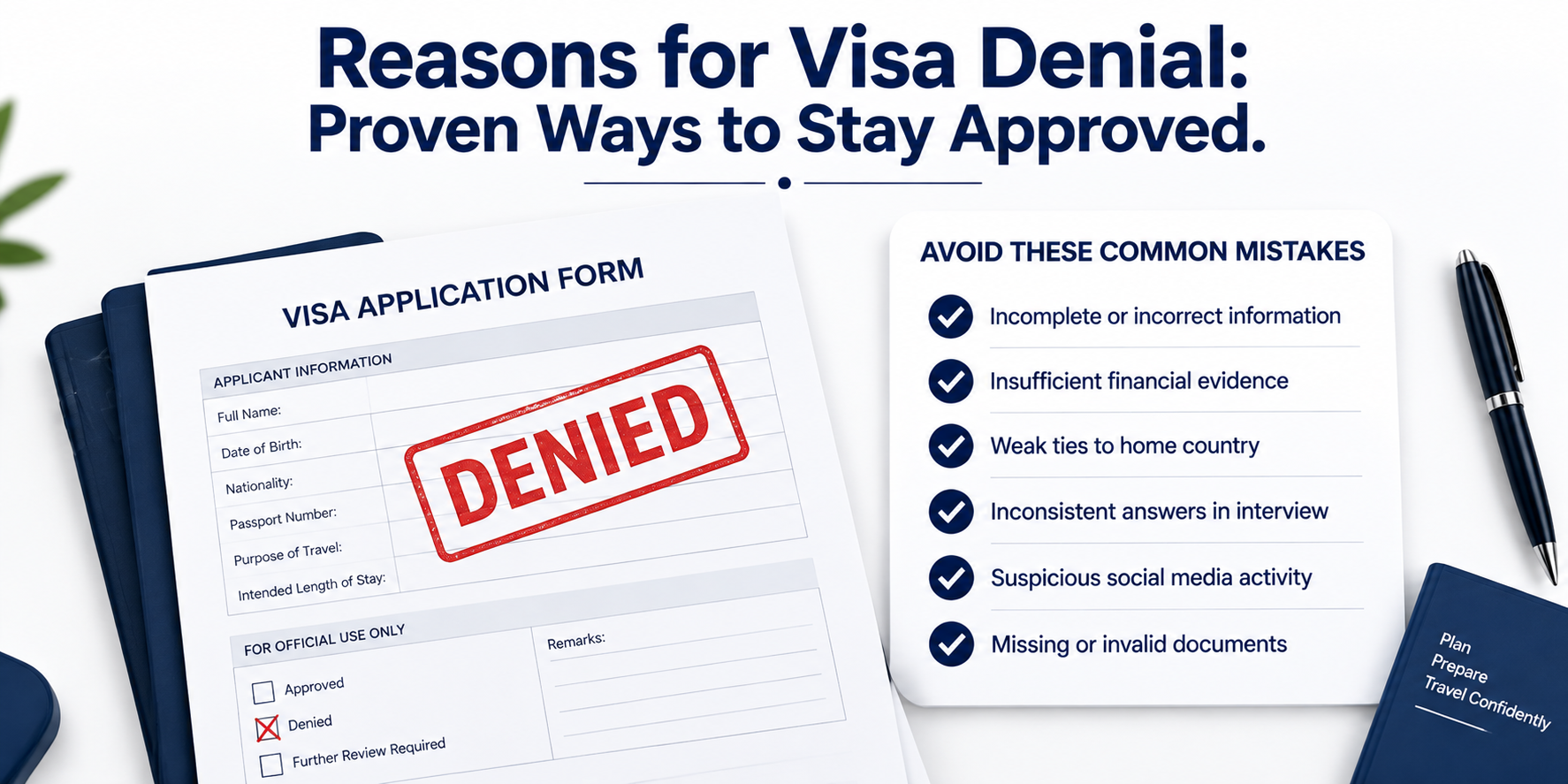
The Most Common Reasons for Visa Denial
Visa denial reasons fall into two groups.
The first is legal grounds: specific sections of US immigration law that make someone ineligible to receive a visa regardless of how strong their application looks.
The second is evidentiary failure: the applicant is eligible, but they did not prove it convincingly enough for the officer to say yes.
Most denials come from the second group. The application was not fraudulent. The person was not technically ineligible. They just did not prove their case in a way the officer could approve.
Section 214(b): Failure to Prove You Will Go Home
This is the most common reason for non-immigrant visa denial. Full stop.
Under Section 214(b) of the Immigration and Nationality Act, every visa applicant is assumed to be planning to stay in the US permanently. The burden is on you to prove otherwise.
To do that, you need to show the officer strong reasons why you will return home after your visit. A steady job. Property you own. Family who depend on you. Financial obligations. Community ties. The officer is looking for evidence that your life is rooted somewhere outside the US.
This denial reason hits hardest in countries with high emigration rates: Nigeria, Ghana, Kenya, India, and Bangladesh among them. It is not a judgment on your honesty. It is the officer’s risk calculation about whether you are likely to overstay.
Common mistakes that trigger a 214(b) denial:
- Attending the interview without documented proof of home country ties
- Quitting your job recently before applying
- Having close family already in the US with nothing strong keeping you home
- Giving vague answers about why you are going and when you plan to return
Section 221(g): Missing Documents or Additional Checks
A 221(g) notice is not always a final refusal. It means the officer could not complete the decision based on what was submitted.
There are two versions. The first is a request for missing documents. You provide them and the process continues. The second is administrative processing, where additional security or background checks are needed. That one is outside your control and can take weeks or months.
If you receive a 221(g) notice, read it carefully. It will tell you which situation applies. Do not assume your visa is denied until you know for certain which version you are dealing with.
Not Having Enough Money
Consular officers check whether you can actually afford the trip without working illegally or relying on someone else to support you indefinitely.
For tourist visas, that means bank statements showing a stable balance that makes sense for the trip you are claiming to take. A large deposit made right before your application is a red flag. Officers see it regularly and they know what it looks like.
For student visas, you need to show you can cover tuition and living costs for the full programme without illegal employment.
For H-1B and other work visas, the employer must show they can pay the prevailing wage from the start of the petition.
The most common mistake: submitting bank statements without context. A high balance with no explanation of where it came from raises more questions than a moderate, consistent balance built from regular salary deposits over time.
Criminal History and Security Grounds
Certain criminal convictions make you inadmissible regardless of anything else in your application. These include crimes involving moral turpitude, drug offences, multiple convictions, and sentences of five or more years.
Security grounds include suspected ties to terrorist organisations, involvement in persecution, or serious human rights violations.
Most of these grounds cannot be overcome without a waiver, and waivers are rare and difficult to obtain. If any of this applies to your situation, speak to an immigration attorney before you apply.
Previous Immigration Violations
Overstaying a previous US visa, entering without authorisation, or being deported creates real barriers to future approval.
Staying more than 180 days past your departure date triggers a three-year bar on re-entry. Staying more than a year past it triggers a ten-year bar. Both bars apply from the day you left the US.
Previous visa denials do not automatically stop you from reapplying. But you must disclose them. Hiding a previous denial is treated as misrepresentation and can permanently bar you from future US visas.
Public Charge Concerns
For immigrant visas and certain non-immigrant categories, officers assess whether you are likely to become dependent on US government assistance.
This looks at your age, health, family situation, employment history, and financial resources. Having received certain public benefits in the past can trigger more scrutiny.
For tourist and student visas, public charge is rarely the primary issue. But weak financial documentation creates similar concerns even in categories where public charge is not technically the stated ground for denial.
Fraud and Misrepresentation
This is one of the most serious reasons for visa denial. A finding of misrepresentation can result in a permanent bar on future US visa applications, sometimes without the possibility of a waiver.
Fraud does not have to be intentional to be treated seriously. Submitting inaccurate documents, using a name that differs from your official records, or failing to disclose previous denials can all be treated as misrepresentation.
The US consular system cross-checks extensively. What you say in one application gets compared against previous applications, public records, and now your social media accounts. Inconsistencies between these sources are flagged as potential misrepresentation even when the applicant had no intention to deceive.
The Biggest Visa Denial Risk in 2026 That Nobody Is Talking About
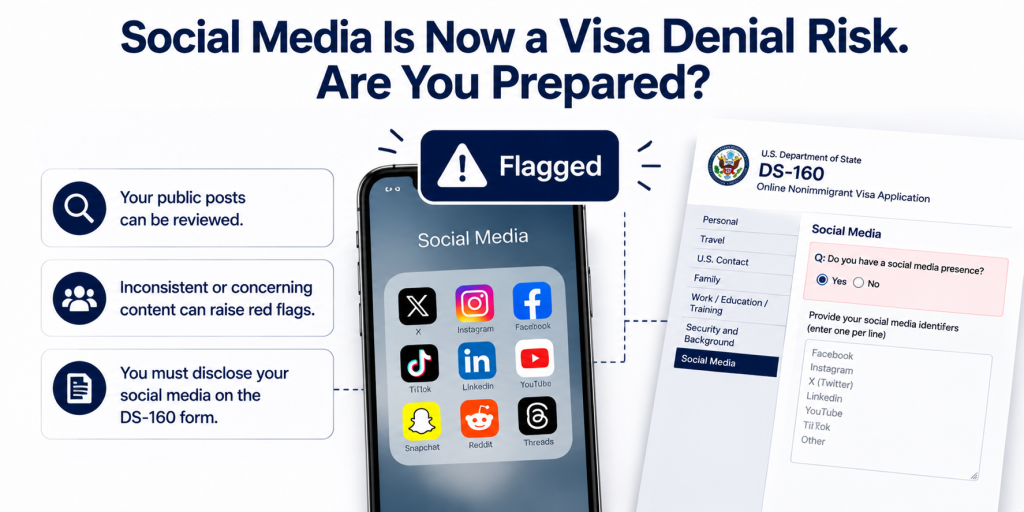
Social media is now one of the most active reasons for visa denial in the current system. Most applicants do not know this. Most agents are not checking for it.
How Social Media Screening Works in 2026
Starting in June 2025, the US Department of State began mandatory social media screening across all major visa categories. H-1B and H-4 applicants were added in December 2025. Over a dozen more categories were added on March 30, 2026.
If your visa category is affected, you must disclose all social media handles used in the past five years on your DS-160 application form. Consular officers review those accounts as part of vetting.
What they look for: content that contradicts your stated purpose of travel, lifestyle signals that do not match your declared financial status, connections to flagged individuals or organisations, and evidence of previous US presence during periods when you had no authorised status.
What they are not supposed to use against you: personal religious content, political opinions, cultural expression, and ordinary personal posts that raise no security or credibility concerns.
Real Cases Where Social Media Led to Visa Loss
In 2025, more than 6,000 international student visas were revoked in the US. Many were linked to social media activity. Some students lost their visas simply for liking or sharing posts online.
Rümeysa Öztürk, a doctoral student at Tufts University, was detained in March 2025. The Department of Homeland Security cited her co-authorship of a student newspaper opinion piece as the reason. A federal judge later ruled it was not valid grounds for detention.
A Norwegian traveller was denied entry at the US border after officers found a political meme about a senior US official on his phone during inspection.
The State Department ran a programme called “Catch and Revoke,” using AI tools to scan tens of thousands of visa holders’ accounts for content considered politically problematic or contrary to US interests.
What the US Mission Nigeria Warning Said
In August 2025, the US Mission in Nigeria posted a direct warning on its official X account to Nigerian visa applicants. The message was clear: failing to disclose social media accounts on a visa application could mean denial and permanent ineligibility for future US visas.
A former Nigerian career diplomat publicly warned that anything posted in a comment section, even years before an application, could be found during vetting. Nigeria’s federal government responded by announcing reciprocal visa measures for US applicants.
For Nigerian applicants, this is not background information. Nigeria’s B1/B2 visa denial rate is already 57 percent. Adding a social media disclosure failure to that environment can end any chance of approval.
What Consular Officers Are Actually Looking For Online
Officers review publicly visible content on the accounts you disclose. They cannot access your private messages or content behind privacy settings.
They check whether your name, photo, employer, and location match your application. They look for posts that directly contradict your stated purpose of travel. They check for evidence of unauthorised work or US presence during periods when you had no valid status.
They are not reading your food posts or judging your personal life. The review is focused on credibility and security.
The practical steps: set your accounts to public before your interview as required for affected visa categories, make sure your professional information is consistent with your application, and disclose every account used in the past five years, including inactive ones.
For a full breakdown of how social media screening works and how to prepare, read our guide on US visa social media screening.
Application Inconsistency: The Visa Denial Trigger Nobody Sees Coming
This reason for visa denial surprises more applicants than any other. The application looked complete. The documents were all there. But something did not add up, and the officer noticed.
What Inconsistency Actually Means
Application inconsistency means two or more pieces of information about you contradict each other. The contradiction might be between your visa form and a supporting document. It might be between a document and your LinkedIn profile. It might be between what you said in a previous interview and what you are saying now.
Inconsistency is not the same as lying. Many applicants have genuine inconsistencies they are completely unaware of: a job title that evolved without the application being updated, a bank balance that does not match actual financial behavior, or location data visible on social media that does not match what was declared.
Consular officers are trained to find these patterns. When they do, they treat them as credibility issues, not clerical errors.
How LinkedIn Creates Visa Denial Risk
This is the most common source of inconsistency for professional visa applicants in 2026 and it catches people completely off guard.
An H-1B petition lists the job title as “Software Engineer.” The applicant’s LinkedIn profile says “Lead Software Engineer” and describes managing a team of five. The petition says the applicant works under supervision. That contradiction is visible to any officer reviewing the accounts and it raises serious questions about what the applicant actually does.
An F-1 student applicant claims full-time enrollment at a university. Their Instagram shows them in a different city, running what appears to be a business, with no reference to student life. The officer draws their own conclusions.
These situations do not automatically mean denial. But they put the officer in the position of deciding whether to give the benefit of the doubt. In a high-refusal-rate environment, they often do not.
Financial Pattern Inconsistencies
Bank statements tell a story. Officers read it.
A large deposit one month before the application with irregular deposits in the year before it raises questions about where the money came from. A salary that looks reasonable on paper but a lifestyle on social media that does not match it creates doubt.
The issue is not the amount in the account. The issue is whether the financial picture in the application is consistent with everything else the officer can see about you.
How to Check Your Own Application Before It Goes In
Search your own name in a browser you are not logged into. What comes up? Does it match what is on your application?
Go through your LinkedIn, Facebook, Instagram, and any other platform. Does your job title, employer, location, and education match your application exactly? Note every difference, even small ones. Decide whether to update the profile or explain the difference in the application.
Look at your bank statements as a stranger would. Is the financial story clear and consistent? Or does it raise questions that you would struggle to answer in an interview?
If you are an immigration professional, this check should happen for every client before submission. One inconsistency you miss becomes an RFE or a denial that costs your client time and costs you credibility.
Visa Denial Rates by Category in 2026
Tourist and Visitor Visa Denial Rates
The B1/B2 tourist visa has some of the highest refusal rates of any US visa category, particularly for African and South Asian applicants.
In FY2025: Nigeria’s B1/B2 refusal rate was 57 percent. Kenya’s was 68.23 percent. Ghana’s was 64.34 percent. Somalia’s was 83.52 percent. More than 15 African countries had refusal rates above 60 percent.
The global B1/B2 refusal rate climbed from 23 percent in 2015 to 35 percent in 2025, driven by tighter scrutiny of home country ties and financial documentation.
Student Visa Denial Rates
F-1 student visa denials reached a decade high of 35 percent globally in 2025, up from 31 percent in 2024.
African students faced a 64 percent average F-1 denial rate. India’s F-1 refusal rate climbed from 53 percent in 2024 to 61 percent in 2025. European students maintained a 9 percent denial rate, reflecting a structural disparity in how refusal risk is distributed globally.
These increases track directly with the rollout of social media screening and tighter financial documentation standards. They are not coincidental.
Work Visa Denial Rates
H-1B denial rates dropped to 2.15 percent in FY2025, the lowest in over a decade. For employer-sponsored specialty occupation petitions with strong documentation, the system is working.
But O visa denial rates rose from 5 percent to 7.3 percent between Q4 FY2024 and Q4 FY2025, a 65 percent increase. EB-2 National Interest Waiver denials surged to 37.2 percent in Q1 FY2025, exceeding even EB-1A extraordinary ability denials at 25.1 percent.
The pattern is clear: categories requiring subjective evidence of extraordinary ability are seeing harder scrutiny. Categories with clear employer sponsorship and wage requirements are doing better.
K-1 and Family Visa Denial Rates
K-1 fiancé visas have approximately a 25 percent denial rate. The CR-1 spousal visa runs at 8 to 9 percent. The difference is largely because K-1 applicants have not yet legally established the relationship through marriage, making it harder to prove authenticity.
Enhanced scrutiny in 2026 has raised the bar for evidence that would have been acceptable in previous years.
What Happens After a Visa Denial
Refusal vs Denial: What Is the Difference
A 214(b) or 221(g) refusal means the officer could not approve the application based on what was submitted. It is not a permanent bar. You can reapply once you have genuinely addressed the reasons for the refusal.
A denial based on inadmissibility grounds, such as criminal history, fraud, or security concerns, is more serious. Some grounds carry permanent bars. Some can be overcome with a waiver, but waivers are complex and approval is not guaranteed.
Knowing which type of decision you received tells you what your next step actually is.
Can You Reapply After a Visa Denial
Yes, in most cases. A 214(b) refusal does not block you from reapplying. But reapplying with the same evidence and the same application is unlikely to produce a different result.
Before reapplying, understand specifically what the officer found unconvincing and fix that exact thing. If it was weak home country ties, strengthen them: employment letters, property documents, family obligations, financial stability. If it was a 221(g) administrative processing hold, follow up on the status and provide whatever information is being requested.
How Long Should You Wait Before Reapplying
There is no mandatory waiting period after a 214(b) refusal for most non-immigrant visa categories. However, applying again too quickly without addressing the actual problem is unlikely to help and may add another refusal to your record.
Most immigration professionals suggest waiting three to six months to let circumstances change and new evidence develop. If nothing has changed, waiting does not help either.
What to Fix Before You Reapply
Target the specific reason for your denial, not the category.
If it was weak home country ties, document them specifically. If it was financial documentation, show consistent income over a longer period rather than just the month before the application. If social media flags contributed, review and update your accounts so they are consistent with your application before resubmitting.
If document inconsistencies were the issue, resolve every one of them before a new application goes in.
How Immigration Professionals Can Prevent Visa Denials Before They Happen
For immigration agents, consultants, and lawyers, the reasons for visa denial listed above are not just useful context for client conversations. They are a review checklist for every application before it leaves your office.
Why Pre-Submission Review Has Never Mattered More
The visa environment in 2026 is more demanding than it was two years ago. Denial rates are climbing. Social media screening is mandatory across most major categories. Financial documentation standards are stricter. USCIS is applying heightened scrutiny to subjective evidence categories.
Submitting without a thorough review in this environment is submitting blind.
The cost of a visa denial is not just the application fee. It is the client relationship, the professional reputation, and the months of delay that follow every refusal. Pre-submission review is the most effective single thing an immigration professional can do to reduce avoidable denials.
The Three Areas Every Agent Should Check Before Filing
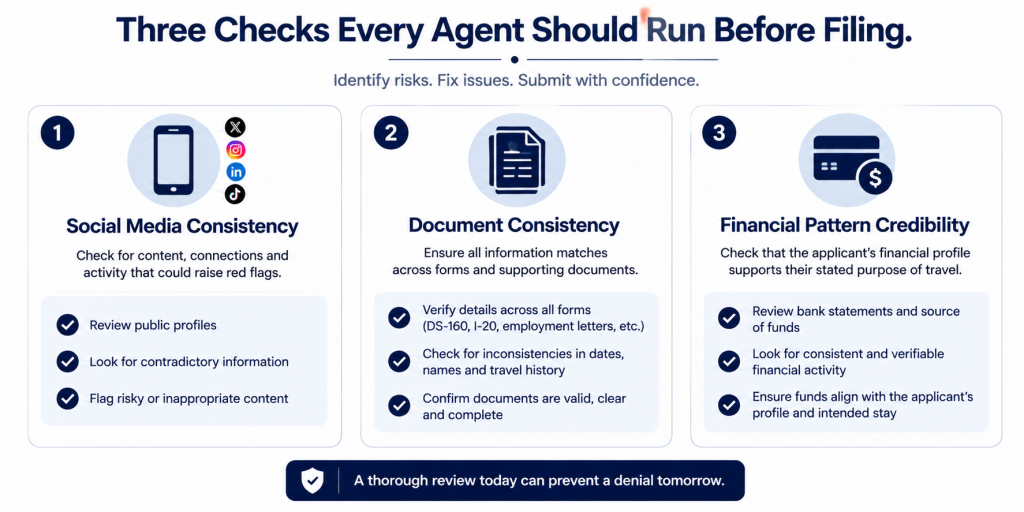
Social media consistency: Check that every publicly visible account is consistent with the application details. Job title, employer, location, education, and financial lifestyle should all align before anything goes in.
Document consistency: Every document in the package should tell the same story. Employment letters, bank statements, tax records, and application forms should not contradict each other on any material point.
Financial pattern credibility: Bank statements should show a financial picture that is consistent with the declared income and the stated purpose of travel. Large unexplained deposits, irregular income patterns, and lifestyle signals on social media that do not match the declared financial situation are all visa denial risk factors.
How VizaCheck Catches Visa Denial Risks Before Submission
VizaCheck was built specifically to surface the kinds of problems that cause visa denials before they reach a consular officer.
The Social Media Risk Intelligence layer checks the client’s publicly visible online presence against their application details. It flags content that contradicts the stated purpose of travel, lifestyle signals that do not align with declared financial status, and behavioral indicators that affect credibility in the officer’s assessment.
The Application Consistency Engine cross-checks every document in the application for contradictions. It aligns employment history, travel records, and educational background across all submitted documents and applies country-specific scrutiny logic to flag the issues most likely to trigger a visa denial or RFE for applicants from a given nationality.
The Document Intelligence layer analyses bank statements for pattern inconsistencies, verifies employment and company details, and identifies fraud indicators that could raise questions about the application’s credibility.
Together these three layers give immigration professionals a complete risk picture before a single page is submitted. The issues that would have appeared as a denial are found while there is still time to fix them.
In a year when Nigeria’s B1/B2 visa denial rate is 57 percent and African F-1 denial rates average 64 percent, filing without a pre-submission check is not a minor oversight. It is the difference between a professional who prevents denials and one who spends time explaining them.
Ask your immigration consultant or attorney whether they use VizaCheck before filing.
Learn how VizaCheck helps immigration professionals file with confidence
Most visa denials are not random. They come from the same places: weak home country ties, financial inconsistencies, document contradictions, social media flags, and credibility gaps that a proper review would have caught before the application went in.
The applicants and professionals who catch these things early get better outcomes. The ones who find them in a refusal notice start over.
Check early. File clean.
What are reasons for a visa to be denied?
Visas are denied for a range of reasons, but most fall into a few clear categories. The most common are failure to prove strong ties to your home country, insufficient financial documentation, previous immigration violations such as overstaying a prior visa, criminal history, fraud or misrepresentation on the application, and public charge concerns. In 2026, social media inconsistencies have become an increasingly significant reason for visa denial, with officers now reviewing publicly visible accounts as part of mandatory screening across most major US visa categories. Document inconsistencies between the application and publicly visible professional profiles like LinkedIn are also triggering more denials than before.
What is the most common reason for visa refusal?
Section 214(b) of the Immigration and Nationality Act is the single most common ground for non-immigrant visa refusal. Under this section, every applicant is legally presumed to be an intending immigrant unless they can prove otherwise. The officer must be satisfied that you have strong enough reasons to return home after your visit, through documented employment, property ownership, family responsibilities, financial obligations, or community ties. When applicants cannot demonstrate those ties convincingly during the interview, the officer has no legal basis to approve the visa. This disproportionately affects applicants from countries with high emigration rates including Nigeria, Ghana, Kenya, and India.
What is the most common visa rejection?
The B1/B2 tourist and visitor visa has among the highest rejection rates of any US visa category, particularly for applicants from Africa and South Asia. In FY2025, Nigeria’s B1/B2 refusal rate was 57 percent, Kenya’s was 68.23 percent, and Ghana’s was 64.34 percent. The global B1/B2 refusal rate reached a decade high of 35 percent in 2025. The F-1 student visa is the second most commonly rejected category, with African students facing an average denial rate of 64 percent and Indian students seeing their refusal rate climb to 61 percent in 2025. Both categories are denied primarily on Section 214(b) grounds, meaning the officer was not convinced the applicant would return home.
What is the difference between visa refusal and visa denial?
These two terms are often used interchangeably but they have distinct meanings in US immigration. A visa refusal, most commonly under Section 214(b) or 221(g), means the consular officer could not approve the application based on the evidence provided. It is not a permanent bar. The applicant can address the specific reasons and reapply. A visa denial based on grounds of inadmissibility, such as criminal history, fraud, security concerns, or immigration violations, is more serious. Some inadmissibility grounds carry permanent bars on future applications. Others require a formal waiver to overcome, which is a separate and complex legal process. Knowing which type of decision you received is the starting point for any next steps.
Can a visa be denied because of social media?
Yes, and it is happening more often than most applicants realise. Since June 2025, the US Department of State has been rolling out mandatory social media screening across all major visa categories. Officers review publicly visible accounts you disclose on your DS-160 form and use them to check whether your online presence is consistent with your application. Content that contradicts your stated purpose of travel, lifestyle signals that do not match your declared financial status, or connections to flagged individuals can all contribute to a denial. In 2025, over 6,000 international student visas were revoked in the US, with many cases linked to social media activity including students who lost their visas simply for liking or sharing posts online. The US Mission in Nigeria also issued a formal warning in August 2025 that failing to disclose social media accounts on a visa application could result in denial and permanent future ineligibility.