EB1 C priority date tracking was never part of the plan. You built your career, your company filed your I-140 petition, USCIS approved it, and then you found out the approval was just the beginning. The real wait starts after.
So every month, you open the visa bulletin. You find the EB-1C row. You check the date. You do the math. And you wonder if this is finally the month things move.
This guide tells you exactly where the EB-1C priority date stands in August 2026, what it means for your case, and what to do right now whether your date is current or not.
Table of Contents
What Is the EB1 C Priority Date and How Is It Set
Your EB1 C priority date is the date USCIS received your I-140 petition. It shows up on your USCIS receipt notice, and it is your place in the green card line.
Think of it like a queue number. The visa bulletin tells you which numbers are being called each month. Until your number comes up, you wait.
How Your Priority Date Is Established
The date is set the moment USCIS receives your petition, not when they approve it.
Say your employer filed in January 2023 and USCIS approved it in August 2023. Your priority date is still January 2023. The seven months of processing time do not count. The receipt date is what matters and it never changes.
One thing worth knowing: if you had an approved I-140 in another employment category like EB-2 or EB-3 that was later withdrawn, you may be able to carry that earlier date into your EB-1C case. This is called priority date retention and it can cut your wait time significantly. Ask your immigration professional about it early.
Why the EB-1C Has a Priority Date at All
The EB-1C used to be current for everyone. No backlog. You got your I-140 approved and you could file straight away.
That changed as more people from high-demand countries moved into the EB-1C queue, particularly those transitioning out of long EB-2 and EB-3 waits. US immigration law caps how many people from any one country can get an employment-based green card each year, regardless of how many qualify. So two people with the same qualifications can end up with very different wait times simply because of where they were born.
Current EB1 C Priority Date by Country: August 2026
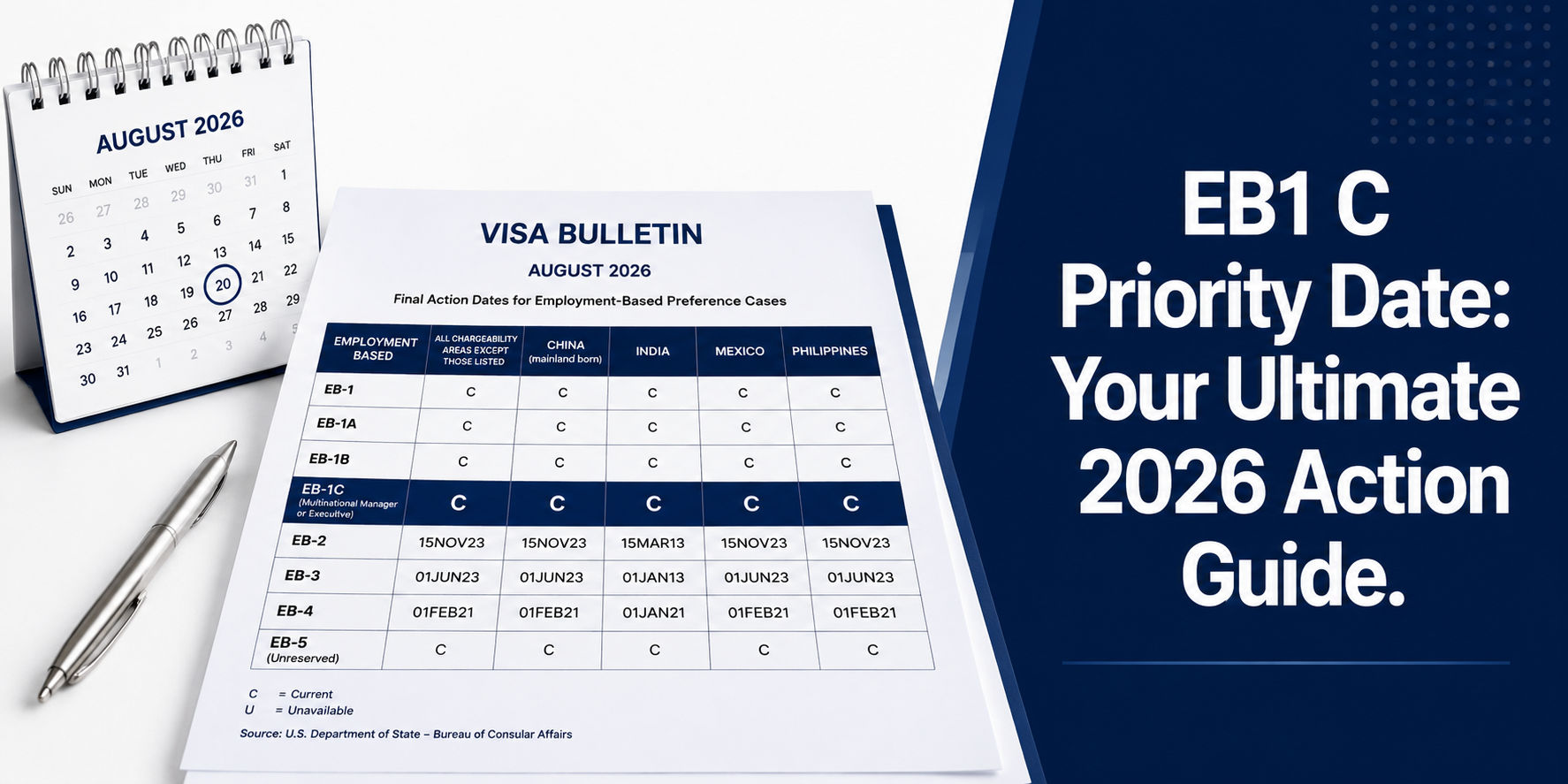
The August 2026 Visa Bulletin is out. Here is what the numbers say for EB-1C.
EB-1C Priority Date for Rest of World
If you were born outside of India or China, the EB-1C is current for you in August 2026. No backlog. No cutoff date. If your I-140 is approved, you can file your I-485 or start consular processing right now.
If you are in this position and have not yet filed, stop waiting. File now.
EB-1C Priority Date for India and China
For applicants born in India, the Final Action Date is October 15, 2022. Only applicants with a priority date on or before that date can file right now.
For applicants born in China, the date moved forward by one month to July 1, 2023. If your priority date is on or before July 1, 2023, you can file in August 2026.
The State Department has also flagged a serious warning: the EB-1C category for India could become unavailable before September 30, 2026. If your date is current, do not sit on it.
Which Filing Chart USCIS Is Using for August 2026
For August 2026, USCIS says all employment-based applicants must use the Final Action Dates chart. The Dates for Filing chart does not apply this month. You can check this directly on the USCIS Adjustment of Status Filing Charts page.
This means no early filing. Your priority date must fall on or before the Final Action Date for your country to file in August 2026.
EB-1C vs EB-1A vs EB-1B: What Is the Difference in the Bulletin
The EB-1 category has three types and they do not always behave the same way in the bulletin. Knowing which one you are in matters.
Why the Subcategory Matters for Your Wait Time
EB-1A covers people with extraordinary ability in fields like science, art, business, or sport. No employer needed.
EB-1B is for outstanding professors and researchers. Requires employer sponsorship.
EB-1C is for multinational managers and executives. Your US employer files the I-140 for you.
All three appear under the same EB-1 row in the bulletin. But demand patterns are different across them, so a policy shift affecting one may not affect the others the same way.
If you came to the US on an L-1A visa as a multinational manager or executive, the EB-1C is your most direct path to a green card. The requirements are nearly identical and your L-1A history supports the EB-1C case, though USCIS will still look at each petition on its own merits.
How to Read Your Category in the Visa Bulletin
Open the bulletin and go to the employment-based section. Find the EB-1 row. Move across to the column that matches your country of birth. That date is your cutoff for August 2026.
“C” means current. You can file. A specific date means your priority date must be earlier than that date to file.
One common mistake: your country of birth controls which column applies, not your citizenship or passport. A British passport holder born in India falls under the India column, not the rest of world current column.
How Cross-Chargeability Can Move Your EB-1C Date Forward
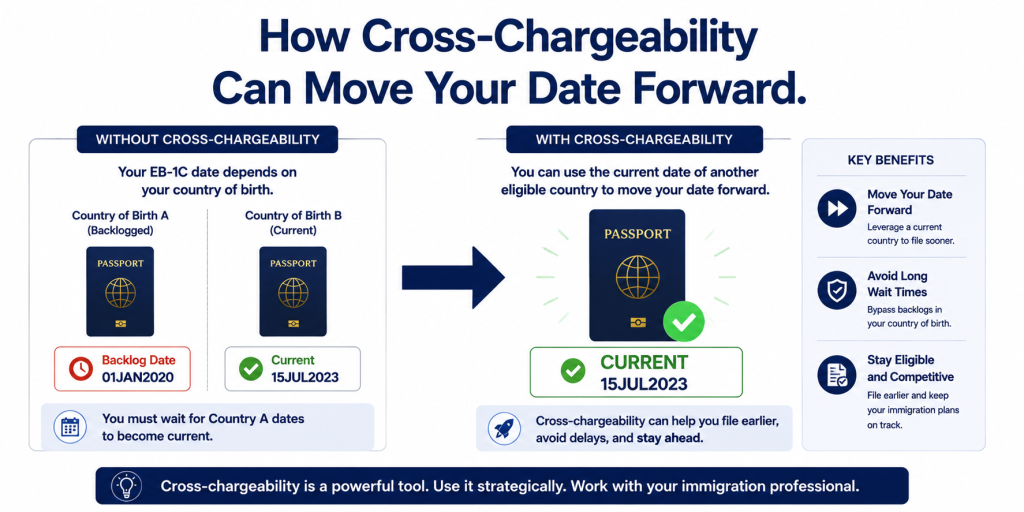
Most EB-1C applicants from India and China do not know this option exists. It can make a real difference.
What Cross-Chargeability Means
Cross-chargeability lets you use your spouse’s country of birth instead of your own, as long as your spouse is also immigrating with you at the same time and their country has an earlier cutoff or is current.
In simple terms: if you were born in India but your spouse was born in the UK, Canada, or Brazil where EB-1C is current, you may be able to file now under your spouse’s country of birth even though your own country has a backlog.
How to Use a Spouse’s Country of Birth to Your Advantage
This applies when both spouses are immigrating together on the same visa category and filing jointly.
Here is an example. An executive born in India has a priority date of March 2023, which is past the current India cutoff of October 2022. His spouse was born in Australia where EB-1C is current. If they file together and cross-chargeability applies, the executive may be charged to Australia’s current date instead of India’s backlogged date.
This does not happen automatically. You have to request it, document it properly, and have your immigration professional confirm you qualify before filing.
If you want to understand what else comes into play once you are ready to file, our guide on US visa social media screening covers what consular officers check and how to make sure your online presence does not slow things down.
What Retrogression Means for Your EB-1C Case
Retrogression is when the State Department moves a cutoff date backward in the following month’s bulletin. A date that let you file this month may not let you file next month.
How Retrogression Happens
When visa numbers in a category run out faster than expected, the State Department pulls the date back to slow down new filings. Applicants who were current one month find themselves back in the queue with no clear timeline for when they will be current again.
The August 2026 bulletin’s warning about EB-1C India is not routine language. It is a real signal that retrogression could come before the fiscal year ends. The date may not just stop advancing. It may go backward.
What to Do If Your Date Retrogresses After You File
Good news here. If you have already filed your I-485 before retrogression hits, your application stays in the system. USCIS holds it and picks up where they left off when numbers free up again. Your work permit and travel document can still be issued or renewed in the meantime. Your spot in the queue is safe from the day USCIS received your application.
This is exactly why filing the moment your date is current matters so much. Once your application is in, retrogression cannot undo that.
What to Do If Your Date Retrogresses Before You File
If retrogression arrives before you file, there is nothing to do but wait. You cannot file until the date advances to your priority date again, even if it was current the month before.
The best thing you can do is stay ready. Have your application prepared and reviewed before each bulletin drops. That way, if your date becomes current, you can file the same week without scrambling.
What to Do While Waiting for Your EB-1C Priority Date
Waiting does not have to mean doing nothing. Here are the things that actually matter during this period.
Maintain Valid Nonimmigrant Status
If you are in the US waiting for your date, you need to keep your visa status active the whole time. For most EB-1C applicants this means renewing your L-1A or H-1B on time without any gaps.
Even a short lapse in status can cause problems when you finally go to file your I-485. It raises questions about your admissibility that take time and effort to resolve. Stay on top of your renewals and make sure your employer is doing the same.
Monitor the Visa Bulletin Every Month
The State Department releases a new bulletin each month, usually in the third week, for the following month. Set a calendar reminder. Check it the day it comes out.
Dates can jump forward in one month and then stall or go backward the next. Finding out two weeks late can mean you miss a filing window that may not come back for months.
Come back here every month for an updated breakdown of the EB-1C priority date and what it means for your situation.
Keep Your Application Ready to File
Start preparing your I-485 package now, not after your date becomes current. Get your medical exam done. Collect your civil documents. Go through your employment and travel history for anything that looks inconsistent.
When your date comes up, you want to file in days. Not weeks. In a category where retrogression is a real possibility, being slow can cost you the window entirely.
How VizaCheck Prepares Your Agent to File Without Errors
When your date becomes current, you need your immigration professional ready to file immediately, not discovering problems for the first time.
Immigration professionals who use VizaCheck review their clients’ full application risk profile before submission. VizaCheck’s Application Consistency Engine checks your visa forms against each other, catches contradictions in your employment, travel, and education history, and flags the kinds of issues that typically generate RFEs. The Social Media Risk Intelligence layer checks what is publicly visible about you online and compares it to your application details. The Document Intelligence layer looks at your financial records and employment documents to make sure everything adds up.
For someone who has waited years for this moment, one avoidable error that triggers an RFE and adds three to six months to the process is not just frustrating. It could mean sitting in limbo while visa numbers run dry.
Ask your immigration consultant or attorney whether they use VizaCheck before filing. If they do not, that is worth a conversation.
Why a Clean Application Matters the Moment Your Date Is Current
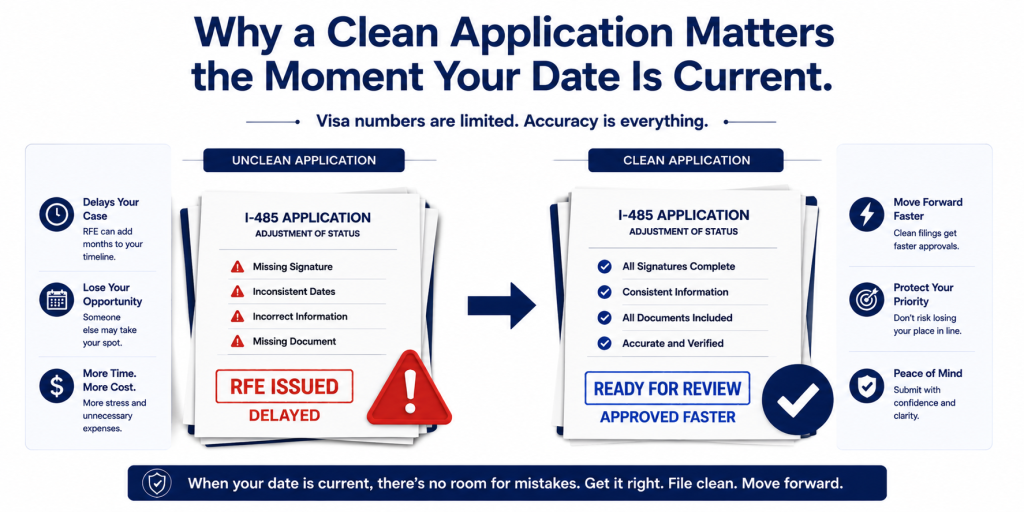
Years of waiting. Monthly bulletin checks. Finally, your date is current. The last thing you want is an RFE slowing everything down now.
The Cost of a Single Error in a Tight Window
An RFE can add three to six months to your processing time. When the State Department is already warning about potential unavailability and retrogression, that kind of delay can mean your case is still pending when visa numbers disappear.
The most common reasons EB-1C cases get RFEs are mismatches between the I-140 and the I-485 supporting documents, differences between what you declared as your employment history and what your public professional profiles show, and gaps or inconsistencies in travel or location records.
None of these are hard to fix in advance. But they are easy to miss when you are assembling a large document package under pressure.
How VizaCheck’s Three Intelligence Layers Protect Your Case
VizaCheck runs through three checks before anything goes to USCIS.
The Social Media Risk Intelligence layer looks at your public online presence and compares it against your application. If your LinkedIn shows a different job title or role description from what is in your I-140, that gets flagged before a USCIS officer ever sees it.
The Application Consistency Engine goes through your visa forms and lines up your employment history, travel record, and educational background across every document. It uses country-specific logic to catch the kinds of inconsistencies that most commonly generate RFEs for applicants from high-demand countries.
The Document Intelligence layer reviews your financial records and employment documentation for gaps or patterns that could raise questions about your employer’s ability to pay or the reality of the role being offered.
Together, these three checks give your immigration professional a clear view of where the risks are before the application is filed.
You have waited long enough. Do not let something fixable make the wait even longer.
Ask your immigration professional about VizaCheck before your next filing. See how it works
Is EB-1C a green card?
Not exactly, but it leads directly to one. The EB-1C is an immigrant visa classification, specifically the first employment preference category for multinational managers and executives. When your EB-1C petition is approved and a visa number becomes available, you can file for permanent residence through either adjustment of status if you are in the US, or consular processing if you are abroad. The end result is a green card. The EB-1C is the pathway, not the green card itself.
What is the current priority date for EB-1C in India?
The current Final Action Date for EB-1C applicants born in India is October 15, 2022, as published in the August 2026 Visa Bulletin. This means only applicants with an I-140 priority date on or before October 15, 2022 can file their adjustment of status or proceed with consular processing right now. The State Department has also warned that the EB-1C category for India may become unavailable before the fiscal year ends on September 30, 2026, making it critical for eligible applicants to act without delay.
Can an EB-1C visa be denied?
Yes, it can. USCIS can deny an EB-1C petition for several reasons. The most common include failure to prove a qualifying relationship between the US and foreign entities, insufficient evidence that the beneficiary worked in a managerial or executive capacity abroad for at least one continuous year within the required period, and a US position that does not genuinely meet the managerial or executive definition. Inconsistencies between the petition and supporting documents are also a frequent trigger for Requests for Evidence that can lead to denial if not resolved. Working with an experienced immigration professional and submitting a thorough, well-documented petition significantly reduces the risk of denial.
How long does it take to get an EB-1C visa?
It depends on your country of birth. For most nationalities, the EB-1C is current, meaning there is no backlog and the process can move quickly once the I-140 is approved. Standard I-140 processing typically takes four to six months, though premium processing can reduce this to around fifteen business days. For applicants born in India or China, the wait is much longer due to per-country caps. Indian nationals currently face a cutoff date of October 15, 2022, which means the total wait from I-140 filing to green card approval can span several years depending on how the priority date moves each month.
What happens to my EB-1C petition if I change employers?
Your approved I-140 petition does not automatically transfer to a new employer. The EB-1C petition is tied to the specific US employer who filed it and the qualifying relationship between that employer and the foreign entity. If you change employers, the new employer would generally need to file a fresh I-140 petition on your behalf. However, if your previous I-140 had been approved for at least 180 days before you changed jobs, you may be able to retain your original priority date and use it with the new petition. This is known as priority date portability and it can protect years of waiting time. Speak with an immigration professional before making any job changes while your case is pending.