You spent weeks gathering documents, booked your visa appointment, and filled out every form correctly. Then your application gets delayed or denied. No clear reason given. What you may not know is that your Instagram, LinkedIn, or X (formerly Twitter) account might have played a role. A social media check for visa is now a standard part of how embassies review applicants, and most people are completely unprepared for it.
The good news is that you can prepare.
Vizacheck runs AI-powered screening across every signal consular officers actually evaluate, so you know exactly where you stand before you apply.
What Is a Social Media Check for a Visa?
A visa social media screening means a consular officer reviews your publicly available online activity as part of deciding whether to approve or deny your visa. It is not guesswork. The current DS-160 form, the standard application used for US nonimmigrant visas, includes a social media question that requires applicants to list every platform they have used in the past five years, along with their usernames and handles.
This is not optional. Leaving it blank or providing incomplete information can raise red flags on its own.
As of June 2025, this practice applies to F, M, and J visa applicants. It expanded to H-1B and H-4 visa applicants in December 2025. The scope is growing fast. Understanding how immigration social media checks work is now essential, not optional.
Do Embassies Actually Check Social Media?
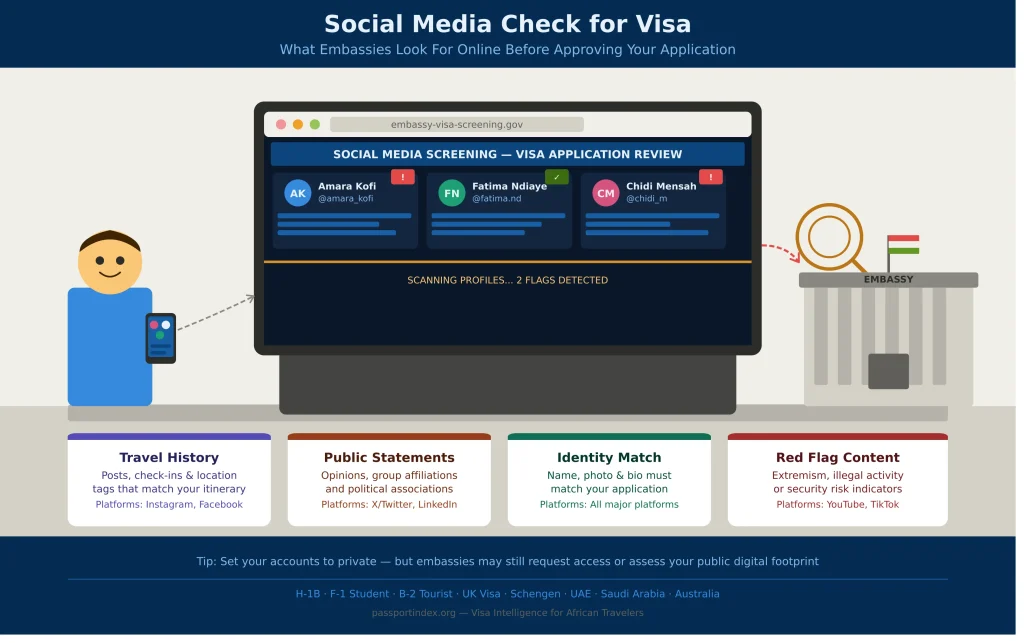
Yes. And they are getting better at it. Consular officers review public posts, comments, photos, affiliations, and other online content across platforms including X/Twitter, Facebook, Instagram, YouTube, and TikTok. They also check LinkedIn and other professional profiles for consistency with your application details, things like job title, employer name, dates, and job duties.
The review is not just about finding something “bad.” It is about looking for inconsistencies. If your LinkedIn says you work in software in Mumbai but your DS-160 lists a different employer, that mismatch alone can slow your application.
Indicators of concern that officers look for include hostility toward the United States, support for terrorism, unlawful antisemitic harassment or violence, potential efforts to steal technical information, or a history of political activism likely to continue in the US. If derogatory information is found, a consular officer may deny the visa or request a follow-up interview.
For a deeper breakdown of how this fits into the bigger picture, read our guide on visa screening and what consular officers are trained to look for.
What Your Visa Background Check Covers Online
Here is what falls under the umbrella of a visa background check social media review:
- Public posts, photos, and shared content going back up to five years
- Political statements, affiliations, or activism-related content
- Consistency between your online bio and your visa application
- Any usernames or handles you disclosed (or failed to disclose) on your DS-160
The US government is expected to closely examine posts touching on politically sensitive subjects that diverge from official US policy. Applicants may need to set all social media accounts to “public” to permit consular inspection.
That last point surprises many people. You cannot hide behind a private account. Applicants are required to adjust the privacy settings on all social media profiles to “public” and keep them that way until the visa has been issued.
How Your Digital Footprint Can Hurt Your Visa
Visa digital footprint problems usually fall into three categories. First, factual mismatches: what you post publicly does not match what you wrote on your application. Second, content flags: posts that a reviewer could interpret as hostile to the US, even if that was not your intent. Third, missing disclosures: failing to list a platform or username you actively used.
Even fully qualified applicants can be routed into administrative processing, leading to longer interview waits and delays that can stretch from weeks into months. The safest approach is to treat your digital footprint as part of your visa file.
Vizacheck was built specifically for this problem. It is AI-powered screening built for how embassies actually check, covering every signal a consular officer evaluates, so you are never caught off guard.
How to Prepare for a Visa Social Media Screening
Preparation is simpler than most people think, but it requires being honest with yourself about what is publicly visible.
- Audit every account listed in your DS-160 and check that your bio, employer, education, and location details match your application exactly
- Review posts from the past five years with fresh eyes. Ask whether anything could be misread out of context
- Do not delete accounts or posts right before applying — that can look like an attempt to hide information
- Keep your accounts public from the moment you submit your application until your visa is issued
Applicants are also advised to preserve copies of their current public profile pages and relevant timelines in case questions arise about historical content viewed during adjudication.
Want to understand how AI tools are being used to assess your online presence? Read this related post on how visa applicants are vetted digitally for more context.
Run Your Own Check Before the Embassy Does
The smartest thing any applicant can do right now is screen themselves first. Vizacheck does exactly that. It scans your digital presence across every signal consular officers use, flags inconsistencies before they become problems, and gives you a clear picture of your social media impact on visa approval before you ever sit down for an interview.
You have already done the hard work of preparing your documents. Do not let an old tweet or a mismatched LinkedIn headline be the reason your application stalls.