One question. Real money. Real deadline.
Do you pay $2,965 for premium processing or go with standard and wait it out?
This guide gives you a straight answer. You will see the current processing times for both options, what premium actually guarantees versus what it does not, how an RFE changes everything, a real cost comparison, three scenarios with a direct recommendation for each, and a table you can scan in under a minute.
By the end, the decision will be clear.
Table of Contents
H1B Standard vs Premium Processing Time: The Key Difference
The difference between H1B standard and premium processing time is simple: one gives you certainty, the other does not.
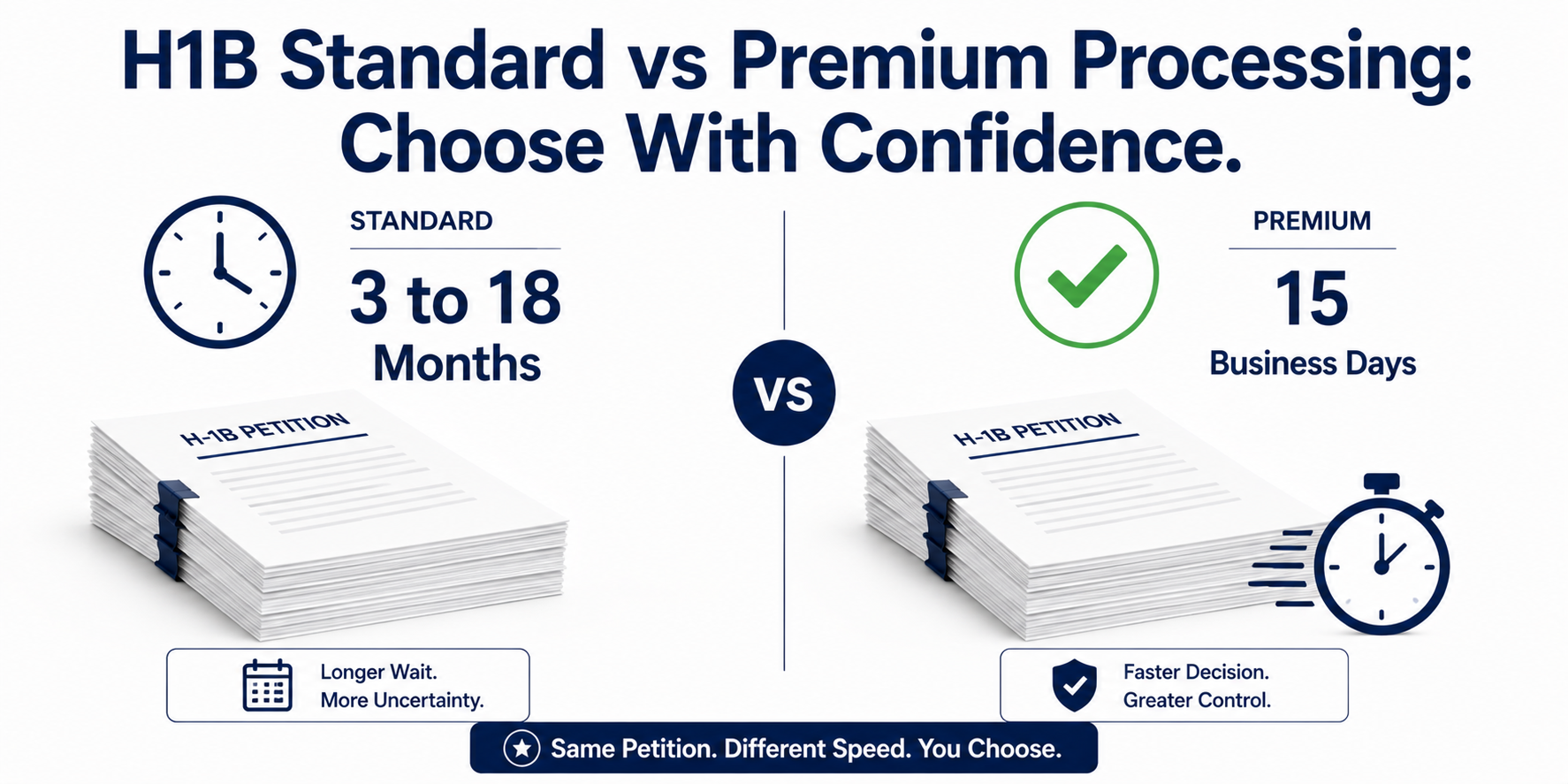
Standard processing costs nothing extra. You join the queue at your assigned service center and wait. The timeline depends on how busy that center is when your petition arrives.
Premium processing costs $2,965. You get a guaranteed decision within 15 business days. That decision might be an approval, a denial, or a Request for Evidence. You are not paying for a yes. You are paying to know the answer faster.
What Standard Processing Actually Is
Standard is the default option. When the employer files Form I-129 without adding Form I-907, the petition goes into the regular queue at the assigned service center.
USCIS works through petitions in order of arrival, based on current workload. There is no timeline commitment. USCIS publishes monthly estimates but they are not binding. Your wait could be shorter or longer than what the tool shows.
What Premium Processing Actually Is
Premium processing means filing Form I-907 alongside the I-129, or submitting it separately to upgrade a petition that is already pending.
The $2,965 fee is on top of all standard filing fees. Once USCIS accepts the I-907 and the payment, a 15-business-day clock starts. At the end of it, USCIS must issue one of three decisions: an approval, a denial, or an RFE.
The clock starts when USCIS accepts the I-907, not when the original I-129 was filed.
The One Thing Both Options Share
Neither standard nor premium processing prevents an RFE. Both are equally exposed to USCIS asking for more evidence. The only difference is what an RFE does to each timeline.
This is what most applicants miss when choosing between H1B standard and premium processing time. Premium gets you a faster first decision. It does not make your petition harder to challenge.
Current H1B Standard vs Premium Processing Times for 2026
Here are the real numbers from the most recent USCIS data as of August 2026.
H1B Standard Processing Time by Service Center
H1B standard processing time varies by service center and changes monthly. Here is where things stand:
Vermont Service Center (EAC): 3 to 4.5 months for new petitions. Vermont handles about 28 percent of all H-1B cases nationally and is currently the fastest center for most petition types. 80 percent of cases are done within 4.5 months.
California Service Center (WAC): 5 to 6 months at the 80th percentile for new petitions. California handles more types of employment-based petitions, which adds to its workload and slows things down.
Texas Service Center (SRC): Similar to California for most petition types. Primarily handles transfers, change-of-status requests, and extensions. Check the USCIS processing times tool monthly since Texas ranges shift frequently.
Your receipt number tells you which center has your case. WAC is California. EAC is Vermont. SRC is Texas. You cannot pick your center. It is assigned based on where your employer files.
For a full breakdown of the H1B approval timeline at every stage of the process, including step-by-step cap-subject timelines and what is causing delays in 2026, read our H1B Approval Timeline 2026: Proven Steps to Get Approved.
H1B Premium Processing Time in 2026
H1B premium processing time is 15 business days, guaranteed, at every service center. USCIS meets that commitment in more than 98 percent of cases.
Historically, the average premium processing resolution has been around 12 days. Most cases wrap up before the 15-day window even closes.
Premium is currently available for all H-1B petition types: new cap-subject petitions, cap-exempt petitions, extensions, transfers, and amendments. No suspensions are in effect.
Standard vs Premium: Side-by-Side Comparison Table
| Factor | Standard Processing | Premium Processing |
| Cost | No extra fee | $2,965 (from March 1, 2026) |
| Timeline | 3 to 18 months by service center | 15 business days guaranteed |
| Timeline certainty | None | 98 percent plus compliance rate |
| RFE impact | Clock pauses, restarts after response | 15-day clock stops, restarts after response |
| Approval guarantee | No | No |
| Who pays the fee | Employer if for business needs | Employer if for business needs |
| Fee refundable | Not applicable | Yes, if USCIS misses the deadline |
| Upgrade option | Yes, via Form I-907 while pending | Already premium |
| Petition types covered | All | All |
| USCIS compliance rate | Not applicable | Over 98 percent |
What Premium Processing Guarantees and What It Does Not
The 15 Business Day Guarantee Explained
When USCIS accepts your I-907 and fee, the 15-business-day clock starts. Business days do not include weekends or federal holidays. USCIS must issue a decision before the clock runs out.
That decision is one of three things. An approval means your petition is granted. A denial means it was rejected. An RFE means USCIS needs more before deciding.
All three count as meeting the premium processing commitment. An RFE is not a failure. It is a valid outcome within the guaranteed window.
What Happens If USCIS Misses the 15-Day Deadline
USCIS refunds the $2,965 fee if they miss the deadline. They still continue processing your petition on an expedited basis after the refund.
This almost never happens given the 98 percent compliance rate. But it is good to know you do not lose your place in the queue. You get the money back and the work continues.
What Premium Processing Cannot Do
Premium processing cannot guarantee approval. It cannot stop an RFE from coming. It cannot speed up the consular appointment that follows USCIS approval for applicants getting a visa stamp abroad. It cannot move an October 1 cap-subject start date earlier. It cannot override how USCIS evaluates specialty occupation or employer-employee relationship requirements.
What it does is exactly one thing: make sure USCIS issues some kind of decision within 15 business days.
How an RFE Affects H1B Standard and Premium Processing Time
What an RFE Does to Standard Processing
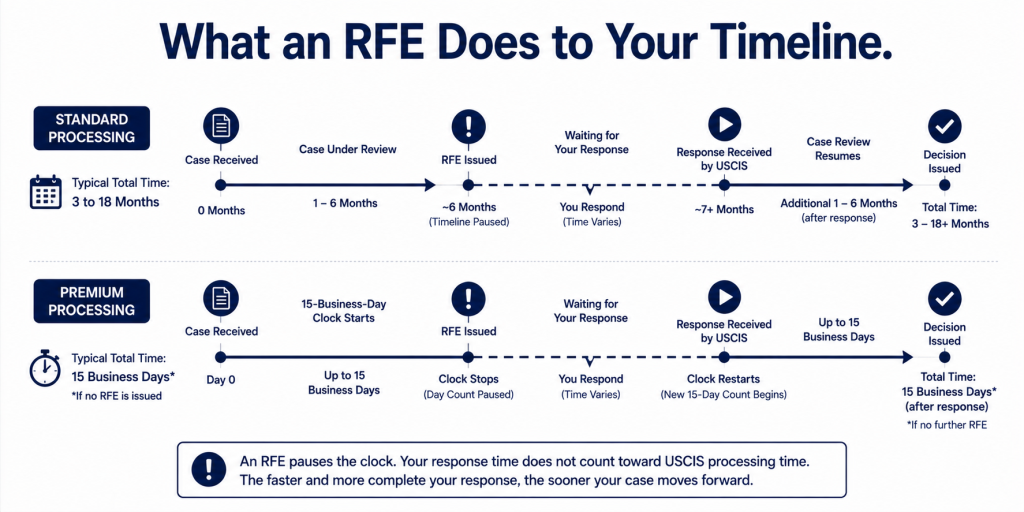
An RFE pauses standard processing. USCIS stops and waits for your response. You have up to 87 days to reply. Once your response arrives, USCIS picks up where they left off.
An RFE under standard processing adds a minimum of two to four months to your total H1B approval timeline, sometimes more.
What an RFE Does to Premium Processing
An RFE stops the 15-business-day premium clock. The clock does not restart until USCIS receives your response. Once they do, a fresh 15-day window begins.
This means premium processing after an RFE can still be relatively quick if your response is fast and complete. Submit within a week and USCIS has another 15 days from that point, meaning your total wait could still be under two months even with the RFE factored in.
A slow or partial response under premium processing cancels out most of the timing advantage you paid for.
A Real Timeline Example With and Without an RFE
Vermont Service Center, standard processing:
No RFE: Filed April 1. Vermont standard runs 3.5 to 4.5 months. Approval expected July to August. October 1 start date is safe.
With RFE: Filed April 1. RFE issued May 15. Response submitted June 15. Processing restarts. Add two to three more months. Approval now September to October. October 1 start date is at risk.
Vermont Service Center, premium processing:
No RFE: Filed April 1 with I-907. USCIS accepts April 3. Decision by April 24. October 1 start confirmed in under four weeks.
With RFE: Filed April 1. Decision by April 24 is an RFE. Response submitted May 5. New 15-day clock starts. Decision by May 26. Total time from filing to final decision: under two months, even with the RFE.
The RFE is the variable that matters most in any H1B standard vs premium processing time comparison. Neither option stops one from coming.
How Much Does Premium Processing Cost in 2026
The Current Fee
The H1B premium processing fee is $2,965 as of March 1, 2026. This is an increase from the previous fee of $2,805.
Most articles online still show $2,805. If you are filing after March 1, 2026, use $2,965. The wrong fee amount will get your I-907 rejected.
Who Pays: Employer or Employee
When premium processing is requested for the employer’s business needs, such as filling a critical role on time, it is generally the employer’s responsibility to pay.
If the employee is the one who wants premium processing for personal reasons, such as getting travel documents faster, USCIS allows the employee to cover it instead.
Immigration attorneys recommend putting this in writing between employer and employee before filing. It avoids disputes later.
Is the Fee Refundable
The $2,965 is non-refundable in almost every case. The only exception is if USCIS misses the 15-business-day deadline. In that situation they refund the fee and continue processing your petition on expedited terms.
The base I-129 filing fees are never refundable regardless of what happens with the petition.
Can You Upgrade From Standard to Premium After Filing
Yes. You can upgrade a pending standard petition to premium at any point while it is still with USCIS.
How to Upgrade
File Form I-907 on its own, referencing your existing receipt number, along with the $2,965 fee. USCIS pulls your petition from the standard queue and starts the 15-business-day premium clock from the date they accept the I-907.
You do not refile the I-129. You are adding premium service to what is already there.
When Upgrading Makes Sense
Upgrade when something changes after you file. A start date got moved earlier. A visa is expiring faster than expected. A job offer depends on approval arriving by a specific date. A new employer needs faster resolution than the standard H1B processing time can deliver.
It also makes sense if standard processing at your service center is running slower than the posted estimates and a real deadline is getting close.
How Fast Does the Upgrade Process
The 15-day clock starts when USCIS accepts the standalone I-907. Upgrades typically move fast because they go to the premium processing unit, which runs a separate queue from standard cases.
The Real Cost-Benefit of Premium Processing
Most people see $2,965 as a cost. The right way to think about it is as insurance. Here is the actual calculation.
If a delay costs the employer a qualified hire: Good candidates do not wait around for three to six months while an uncertain standard petition works its way through the queue. If one walks away, replacing them can cost $20,000 to $50,000 for a senior role when you add recruiter fees, lost productivity, and onboarding time. Against that number, $2,965 is a small line item.
If an employment gap costs the H-1B holder: A gap in lawful status affects more than just the work permit. It can affect mortgage applications, an H-4 spouse’s work authorisation on the EAD, and the kind of daily stress that disrupts performance and relationships. The total cost of a gap, financial and personal, often exceeds $2,965 several times over.
If the start date is flexible and the petition is low-risk: Standard processing is the right call. Paying for certainty when you do not need certainty is wasted money.
The question is not whether $2,965 is a lot. The question is what a delay would cost you if standard processing runs long or hits an RFE.
Three Real Scenarios With a Clear Recommendation
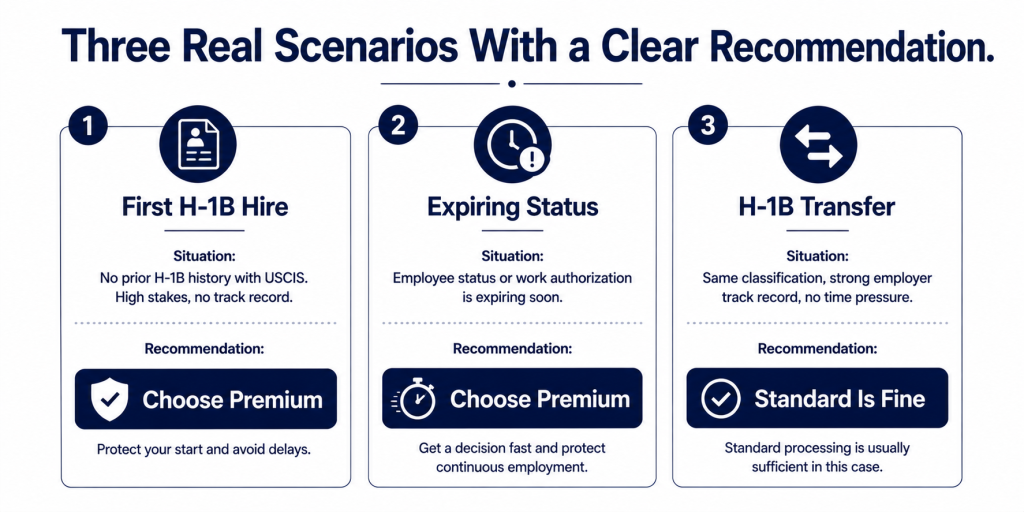
Scenario 1: Tech startup, first H-1B hire, October 1 start date, filing in April
Vermont standard runs 3.5 to 4.5 months from April. That puts approval at July to August. Tight but workable without an RFE. With an RFE, October 1 is in danger.
Choose premium. Losing this hire to another offer while the petition sits in standard processing costs far more than $2,965. Pay for the certainty.
Scenario 2: H-1B extension, current status expires in 90 days, no job change
The 240-day rule lets the employee keep working after status expires if the extension was filed before expiration. Standard processing will not finish before the expiry date but work can continue legally.
Standard processing is acceptable if both employer and employee are comfortable with the 240-day rule period. Premium makes sense if travel is planned or if the employee’s spouse has an H-4 EAD that will also lapse and cannot wait.
Scenario 3: H-1B transfer, employee already working, new employer needs them immediately
Under H-1B portability rules, the employee can start with the new employer as soon as the transfer petition is filed and the receipt notice arrives. No final USCIS approval is needed to begin work.
Standard processing is fine for most transfers. The employee is already working. Unless there is a specific reason to get final approval quickly, like upcoming international travel requiring a fresh visa stamp, $2,965 is not necessary here.
When to Choose Standard Processing
Standard processing makes sense when:
- Your start date is flexible and you have five to six months of buffer before approval is needed
- The petition is straightforward and the RFE risk is low
- It is an H-1B transfer and the employee can already work under portability rules
- It is an extension and the 240-day rule covers the gap between expiry and approval
When to Choose Premium Processing
Pay for premium when:
- Missing the start date has real consequences and standard H1B processing time may not deliver in time
- The current H-1B status expires in under four months and any gap in employment would cause problems
- The case has complexity that could attract questions from USCIS
- International travel is planned after approval and consular appointment timing depends on getting the I-129 decided quickly
- The employer cannot absorb uncertainty in their workforce plan
- The petition is a new consular H-1B where a $100,000 fee applies, making a fast clean approval especially valuable
How to Cut RFE Risk Whatever Processing Type You Use
Choosing premium is not a replacement for filing a strong petition. An RFE disrupts the H1B premium processing time just as much as it disrupts standard. And an RFE under standard processing can push an October 1 start date into the following year.
The smartest move with either processing type is submitting a petition USCIS does not need to question.
That means a job description that clearly proves specialty occupation. An org chart that shows who the person reports to. Credentials that match the role. Financial documents that confirm the employer can cover the salary. And every document in the package consistent with every other document.
How VizaCheck Helps Agents File Petitions That Do Not Trigger RFEs
Immigration professionals who run H-1B applications through VizaCheck before filing are not hoping the petition holds up. They know it does.
VizaCheck’s Application Consistency Engine checks every document for contradictions, catches mismatches between the application and what is publicly visible on the applicant’s professional profiles, and applies country-specific scrutiny logic to find the problems most likely to generate an RFE. If a LinkedIn job title differs from what is in the I-129, VizaCheck flags it before USCIS sees it. If a bank statement raises questions about the employer’s ability to pay, the Document Intelligence layer catches it before the petition goes out.
With H1B RFE rates up 23 percentage points year over year, the processing type you choose matters less than the quality of what you file under either one.
Ask your immigration consultant or attorney whether they use VizaCheck before submitting H-1B petitions.
Learn how VizaCheck helps immigration professionals file with confidence
The H1B standard vs premium processing time decision is simpler than it looks. Standard works when you have time and the petition is clean. Premium is worth it when you cannot afford to wait or when the stakes of a delay are real.
What neither option fixes is a weak petition. The way to protect your timeline, whichever processing type you use, is to file something that USCIS has no reason to question.
Processing times shift every month. Check uscis.gov/processing-times for the latest data and come back here for updated analysis.
Is premium processing worth it for H-1B?
It depends on your situation. If missing your start date would cost the employer a qualified hire, cause an employment gap, or disrupt dependent visa status like an H-4 EAD, then yes, premium processing is worth every cent of the $2,965 fee. The certainty of a 15-business-day decision is more valuable than the cost when the stakes are real. However, if your start date is flexible, the petition is straightforward, and you have at least five to six months of buffer before approval is needed, standard processing is the smarter financial choice. The fee is not the question. What a delay would actually cost you is.
How long does H-1B approval take with premium processing?
With premium processing, USCIS commits to issuing a decision within 15 business days of accepting your Form I-907 and the $2,965 fee. Business days exclude weekends and federal holidays. Historically, the average resolution time has been around 12 days, meaning most cases wrap up even before the 15-day window closes. However, if USCIS issues a Request for Evidence, the 15-day clock stops and only restarts once your response is submitted. In that scenario, the total time from filing to final decision depends on how quickly and completely you respond to the RFE.
How long does H-1B premium processing take in 2026?
In 2026, H-1B premium processing takes 15 business days or less from the date USCIS accepts your I-907 request. The current fee is $2,965, reflecting an increase from $2,805 that took effect on March 1, 2026. USCIS meets the 15-business-day commitment in more than 98 percent of cases across all service centers. Premium processing is available for all H-1B petition types in 2026 including new cap-subject petitions, cap-exempt petitions, extensions, transfers, and amendments, with no current suspensions in effect.
Does H-1B premium processing take more than 15 days?
It can, but only when USCIS issues an RFE. If no RFE is issued, USCIS almost always meets the 15-business-day deadline, with a compliance rate exceeding 98 percent. When an RFE arrives, the 15-day clock pauses and does not restart until USCIS receives your response. How long the total process takes after an RFE depends entirely on how quickly you submit a complete response. If you respond within a week, USCIS has another 15 business days from that point, meaning the total timeline can still resolve in under two months even with an RFE factored in. If USCIS misses the deadline with no RFE, they refund the $2,965 fee and continue processing your case on an expedited basis.
Can my employer upgrade my H-1B from standard to premium after filing?
Yes. You can upgrade a pending standard processing petition to premium at any time while it is still with USCIS. To do this, the employer files Form I-907 as a standalone submission along with the $2,965 fee, referencing the existing receipt number. There is no need to refile the I-129. USCIS pulls the petition from the standard queue and starts a fresh 15-business-day premium clock from the date they accept the I-907. This is worth doing when circumstances change after filing, such as a start date moving earlier, a visa expiring sooner than expected, or a job offer becoming contingent on faster approval.