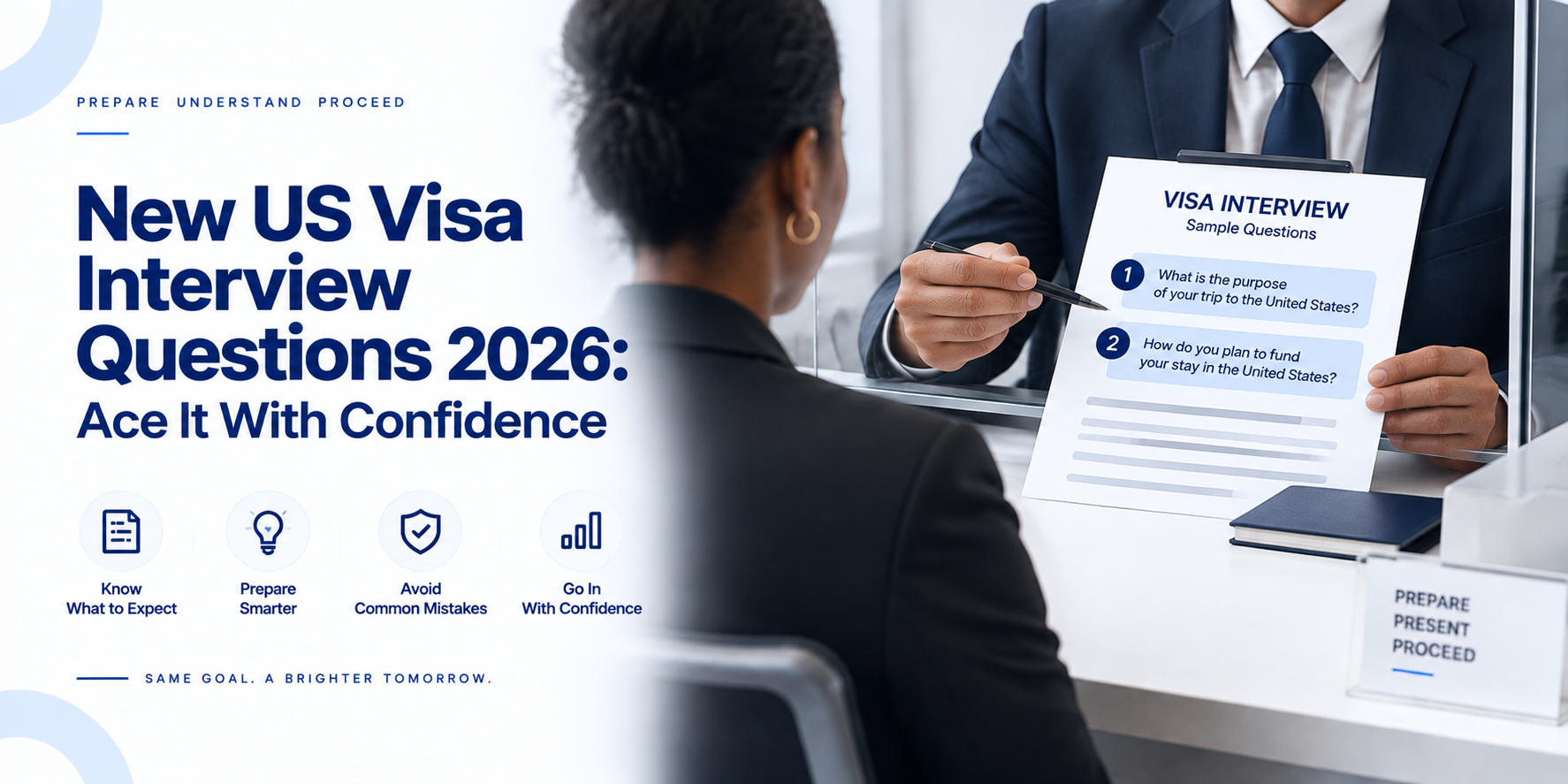
New US visa interview questions 2026 changed the game for every applicant sitting down at a US consulate. Something significant happened in April and you need to know what it is before you walk through that door.
As of April 28, 2026, every applicant for a US non-immigrant visa now faces two new mandatory questions at the start of their consular interview. They apply to tourist visas, student visas, work visas, and every other non-immigrant category. They are asked before the standard interview begins. And how you answer determines whether your interview continues at all.
This guide tells you exactly what the new US visa interview questions are, why they were added, what the right answer looks like, what happens if you say yes, what happens if you lie, and what else changed at the interview stage in 2026 that you need to prepare for.
Table of Contents
New US Visa Interview Questions 2026: What Every Applicant Must Know
The Two New Mandatory Questions Every Applicant Is Now Asked
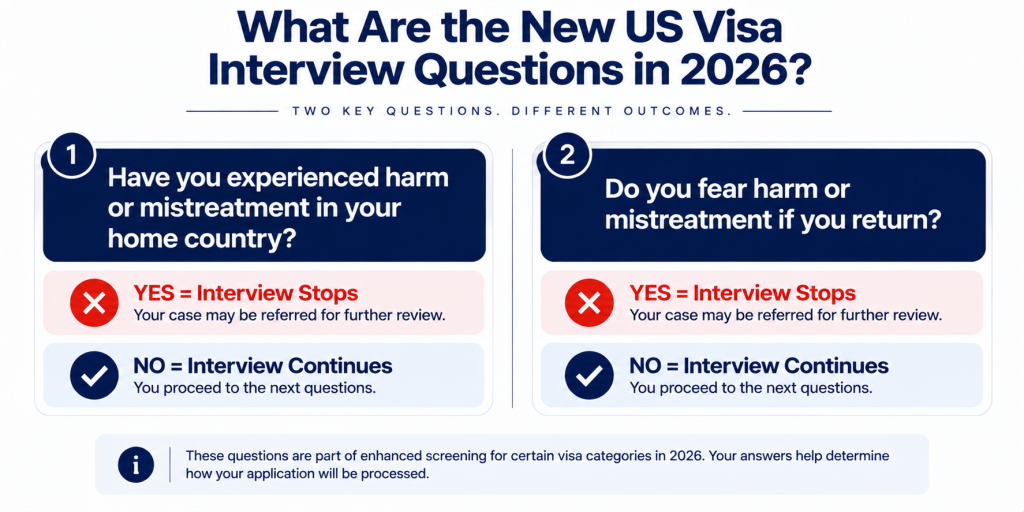
Effective April 28, 2026, consular officers at every US embassy and consulate worldwide now ask all non-immigrant visa applicants these two questions before anything else:
Question 1: “Have you experienced harm or mistreatment in your country of nationality or last habitual residence?”
Question 2: “Do you fear harm or mistreatment in returning to your country of nationality or permanent residence?”
These are not warm-up questions. They are formal screening questions with direct consequences tied to your answer.
You must answer no to both for the officer to continue processing your application. A yes answer to either question stops the interview immediately. A refusal to answer or an unclear response has the same effect.
There is no appeal at the consulate if the interview is stopped at this point.
Why the State Department Added These Questions
The State Department added the new US visa interview questions to catch potential asylum seekers before they reach US soil. According to Fragomen’s official announcement, the change is the result of an April 28 State Department cable directing consular officers worldwide to ask the two asylum-related questions of every non-immigrant visa applicant.
In the past, asylum screening happened after someone arrived in the United States and filed an application. These new questions move that screening to the consular interview abroad, before any visa is issued.
The reason given is that a significant number of people have entered the US on temporary non-immigrant visas and then applied for asylum. The two questions are designed to surface that pattern early.
Here is the legal tension. Non-immigrant visas require you to prove you plan to return home after your visit. Saying you fear going home suggests the opposite. The questions are built to identify that contradiction before a visa is granted.
Which Visa Categories Are Affected
The new US visa interview questions apply to every non-immigrant visa category. That includes:
- B-1/B-2 tourist and business visitor visas
- F-1 student visas
- J-1 exchange visitor visas
- H-1B specialty occupation visas
- H-4 dependent visas
- L-1A and L-1B intracompany transferee visas
- K-1 fiancé visas
- O-1 extraordinary ability visas
- M-1 vocational student visas
If you are going to a US embassy or consulate for any non-immigrant visa in 2026, you will be asked both questions.
What the New Questions Are Actually Testing
The Difference Between Visitor Intent and Immigrant Intent
Every US non-immigrant visa is built on one legal assumption: you are presumed to be planning to stay in the US permanently unless you prove otherwise. This is Section 214(b) of the Immigration and Nationality Act.
The whole interview is designed to test whether you can overcome that presumption, meaning whether you have strong enough ties to your home country that the officer believes you will leave after your visit.
Saying you are afraid to go back directly contradicts that. If you tell the officer you fear returning home, you are telling them you have a reason to stay. That is the opposite of what the visa requires you to demonstrate.
This is why a yes answer stops the interview. The officer has no discretion under the current directive. The question is not weighed against your travel purpose. The interview ends.
Why Saying Yes Creates a Serious Problem
A yes answer to either of the new US visa interview questions results in immediate visa denial. That denial goes on record in the consular system. It follows you to every future visa application.
For applicants from countries with genuine instability, conflict, or political risk, this creates a very difficult situation. Their fear may be real. Their reason for travel may also be entirely legitimate. The current directive does not allow the officer to weigh one against the other.
Immigration lawyers have noted publicly that the new questions create a trap for applicants who have honest answers to them but have genuine temporary travel purposes. The policy does not give room for that nuance at the non-immigrant visa stage.
Why Lying Is the Worst Option
Answering no when your honest answer is yes is not the safer path. It is misrepresentation to a US consular officer. As Fisher Phillips noted in their employer guidance, the consequences of dishonest answers extend well beyond the immediate application.
Under Section 212(a)(6)(C) of the Immigration and Nationality Act, a finding of material misrepresentation can result in a permanent bar from US visas with no waiver available in most cases.
Here is the difference: a 214(b) refusal from a yes answer affects that one application. A misrepresentation finding from a dishonest no can affect every future application permanently.
There is also a practical risk. If you later apply for asylum inside the United States, your consular file will be reviewed. A recorded no to the fear question followed by an asylum claim based on exactly that fear creates a credibility problem that immigration judges will take seriously.
Refusing to answer carries the same consequence as a yes. The interview stops.
How to Answer the New Visa Interview Questions
If You Have No Fear of Returning Home
Say no to both questions clearly and calmly. Do not explain. Do not add context. The officer needs a yes or no. Give them a calm no and the interview moves forward.
If You Have Real Fears But a Legitimate Reason to Travel
This is the hard scenario. Immigration lawyers are dealing with it more and more for clients from Nigeria, Kenya, Ethiopia, Sudan, Myanmar, and other countries where real risks exist alongside genuine travel purposes.
The advice is consistent across multiple attorneys: talk to an immigration lawyer before your interview if there is any chance this question could apply to your situation.
If you have experienced harm or genuinely fear returning, a non-immigrant visa may not be the right route. An attorney can help you work out whether your circumstances fall within the legal definition the State Department is using, what alternative pathways exist for your situation, and what the consequences of different answers would be specifically for your case.
Trying to figure this out alone, when your honest answer is yes, creates risk no matter which way you answer.
What to Avoid Saying
Do not say yes and then try to explain that you still plan to return home. The directive does not give the officer room to hear that. The interview stops at the yes.
Do not say you are unsure or give a conditional answer. Anything other than a clear no is treated as a yes. The interview stops.
Do not say no if your honest answer is yes. The misrepresentation consequences last far longer than a single visa denial.
If you are genuinely unsure whether your situation counts as harm or mistreatment in the legal sense, that is what an immigration attorney is for. Ask before the interview.
What Else Changed at the US Visa Interview in 2026
The two new US visa interview questions are the biggest change, but they are not the only one.
Social Media Screening Happens Before You Sit Down
Since December 2025, H-1B and H-4 applicants have faced mandatory social media screening as part of consular processing. The March 2026 expansion added over a dozen more non-immigrant categories. By the time most applicants arrive for their interview, the officer has already reviewed their publicly visible social media accounts.
This changes the interview dynamic significantly. The officer arrives at the window already knowing things about you. If your social media shows a job, location, or lifestyle that contradicts your application, that information is already in front of them before you speak.
Questions about inconsistencies between your application and what was seen on your accounts may come up during the interview, even if you were not expecting them.
For a full breakdown of what officers check during social media screening and how to prepare, read our guide on US visa social media screening.
Stricter Checks Between Your Application and Your Answers
Consular officers in 2026 have access to more cross-referenced data than ever before. Previous visa applications, entry and exit records, employment history, social media accounts, and your current application are all visible during the interview.
Inconsistencies between what you said in a previous application and what you are saying now, between your documents and your interview answers, and between your social media presence and your declared information are all active risk areas.
According to LawQuest International, officers are now also instructed to look for signs of fear in the applicant’s documents, social media history, and interview responses, and to deny the visa if those signs are present. Applicants run into difficulty not because they failed to memorise sample answers but because they did not identify where their own application was weak before sitting down.
Longer Interview Times and Appointment Delays
Social media screening has made each interview longer. Consulates process fewer applicants per day as a result. Appointment backlogs have grown at high-volume posts.
BAL Immigration Law reported to Google employees that some US embassies and consulates are experiencing visa stamping appointment delays of up to 12 months. Fragomen gave similar guidance to Apple employees.
If you are planning international travel and need a fresh visa stamp to re-enter the US, plan significantly further ahead than you would have in 2024.
How to Prepare for a US Visa Interview in 2026
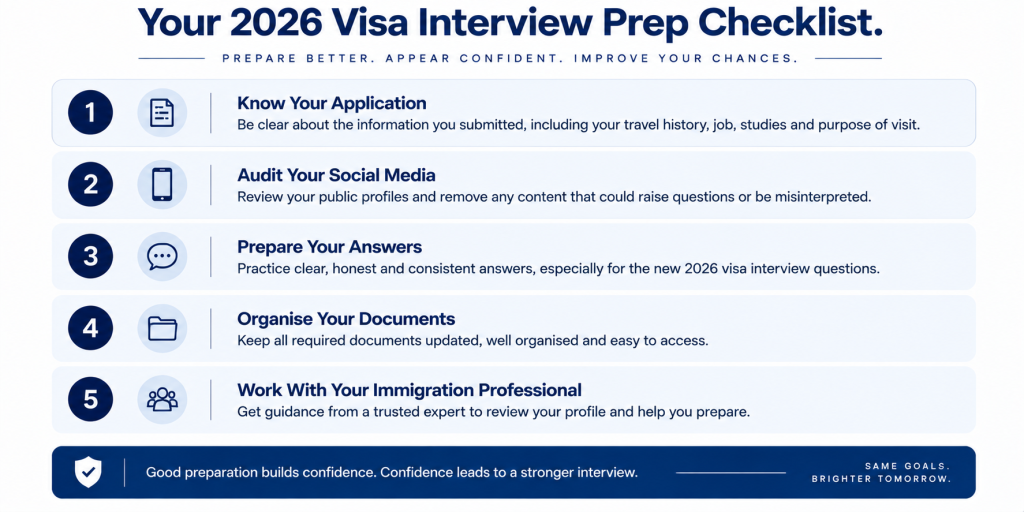
Step 1: Know Your Application Inside Out
Every answer you give must match your DS-160 and supporting documents. Officers check. Inconsistencies between your interview answers and your application are treated as credibility issues, not mistakes.
Before you go in, re-read your DS-160. Review every document you submitted. Know your employment dates, travel history, financial situation, and home country ties well enough to answer questions calmly without looking anything up.
Step 2: Check Your Social Media Before the Interview
Search your own name in a browser you are not signed into. Look at what is publicly visible. Does it match your application?
Does your LinkedIn employer match what you declared? Does your location history align? Are there posts that could be read as contradicting your stated purpose of travel?
Fix anything that is outdated before the interview. Be ready to explain any difference between what is online and what is in your application.
Step 3: Know What You Will Say to the New Questions
Think through your answers to both new US visa interview questions before your appointment day. Do not walk in uncertain about what you will say. They will be asked. They are mandatory.
If your honest answer is a clean no, say it calmly and move on. If your honest answer is more complicated, get legal advice before the interview, not after.
Step 4: Have Your Documents Organised
Have every document your visa category requires and have it easy to find. Officers may ask for specific items during the interview. Being disorganised under pressure wastes time and creates a bad impression.
Tourist visa: bank statements, employment letter, property documents, return flight booking, accommodation details.
Student visa: acceptance letter, financial proof, academic records, home country ties evidence.
Work visa: approved petition, employment offer, educational credentials, prior employment documentation.
Step 5: Work With Your Immigration Professional First
If your application has a previous refusal, gaps in employment, unusual travel history, or anything connected to the new questions, work through it with an immigration professional before the interview.
The officer has minutes to decide. What you prepared before you walked in determines what happens in those minutes.
Nigeria and High-Refusal Countries: What You Need to Know
Why These New Questions Hit Harder Here
Nigeria’s B1/B2 visa refusal rate is 57 percent. Kenya’s is 68.23 percent. Ghana’s is 64.34 percent. In environments where more than half of all applications are already refused, a new mandatory question that stops the interview on a yes answer raises the risk level significantly.
Applicants from these countries are also more likely to come from environments where genuine safety concerns exist alongside legitimate travel purposes. The new US visa interview questions do not allow for that distinction at the consular stage.
The August 2025 Social Media Warning Is Still in Effect
In August 2025, the US Mission in Nigeria posted a formal warning on its official X account: failing to disclose social media information on a visa application could lead to denial and permanent future ineligibility.
That warning has not been withdrawn. It sits alongside the new interview questions as part of a vetting environment that is stricter than anything Nigerian applicants have faced before.
Any Nigerian applicant now faces a pre-interview social media review, two new mandatory questions with no room for nuanced answers, and a 57 percent baseline refusal rate. Preparation has never mattered more.
What to Do Before Your Interview
Go through every social media account you have used in the past five years. Make sure they are consistent with your application before your interview date.
Be clear about your answers to the two new questions before you walk in.
If your honest answer to either question involves any complexity, get legal advice before the interview.
Make sure your financial documentation, home country ties, and purpose of travel documents are specific, strong, and ready to show.
Do not count on the officer giving you the benefit of the doubt. Prepare as if the application has to stand on its own.
How VizaCheck Helps Immigration Professionals Prepare Clients for the New Interview Environment
Why Interview Risk Starts Before the Interview
The new US visa interview questions are asked at the window. But the conditions that determine how they play out start weeks before, when the application is prepared and submitted.
An applicant whose social media contradicts their application walks into the interview with a problem the officer has already seen. An applicant whose financial documentation raises questions walks in with a vulnerability the officer will probe. An applicant with inconsistencies between documents walks in having already given the officer a reason to be skeptical.
The interview is where the risk shows up. The application is where it started.
What VizaCheck Catches Before the Interview Happens
Immigration professionals who use VizaCheck to review client applications before submission are not just helping clients prepare for the interview. They are removing the vulnerabilities that make interviews difficult.
VizaCheck’s Social Media Risk Intelligence layer checks what is publicly visible about the client online and compares it to the application before submission. Issues that would have surfaced at the interview because the officer reviewed the accounts beforehand are found and fixed while there is still time.
The Application Consistency Engine checks every document for contradictions and mismatches between declared information and publicly visible professional profiles. The inconsistencies that turn a routine interview question into a difficult one are found before anything goes in.
The Document Intelligence layer reviews financial records and employment documentation for credibility gaps. The financial questions applicants struggle to answer at the window are addressed at the preparation stage.
A clean application does not guarantee approval. But it removes the avoidable vulnerabilities that make the new US visa interview questions environment harder than it needs to be.
Ask your immigration consultant or attorney whether they use VizaCheck before submitting applications for clients with consular interviews coming up.
Learn how VizaCheck helps immigration professionals file with confidence
The US visa interview in 2026 is not what it was two years ago. Two new questions can end it before it properly starts. Social media screening means the officer already knows things about you before you sit down. Consistency is checked across more data points than ever before.
The applicants who get through are prepared. They know what is coming, have honest answers ready, and have already dealt with the inconsistencies in their application before they arrive at the window.
Prepare before the interview. Not after.
What are the new US visa interview questions in 2026?
As of April 28, 2026, consular officers at every US embassy and consulate worldwide now ask all non-immigrant visa applicants two new mandatory questions before the standard interview begins. The first asks whether you have experienced harm or mistreatment in your country of nationality or last habitual residence. The second asks whether you fear harm or mistreatment in returning to your country of nationality or permanent residence. You must answer no to both for the interview to continue. A yes answer or a refusal to answer results in immediate visa denial with no appeal process available at the consulate.
Why did the US add new questions to the visa interview?
The State Department added these questions to identify potential asylum seekers before they reach US soil. Previously, asylum screening happened after someone arrived in the United States and filed a formal application. The new questions move that screening to the consular interview stage abroad. The policy rationale is that a significant number of people have entered the US on non-immigrant visas and then applied for asylum. The questions are designed to surface applicants with asylum-relevant circumstances before any visa is issued, creating an early screening layer that did not previously exist at the consular level.
What happens if I say yes to the new visa interview questions?
If you answer yes to either of the two new questions, your visa interview stops immediately and your application is denied. The denial is recorded in the consular system and follows you to every future visa application. There is no opportunity at that stage to explain your travel purpose or provide context. The consular officer has no discretion under the current directive to weigh your fear against your stated reason for travel. If you genuinely have fears about returning home but also have a legitimate temporary travel purpose, speak to an immigration attorney before your interview rather than attempting to navigate this situation alone.
Can I lie about my fear to get my visa approved?
No, and doing so creates a far worse outcome than answering honestly. Saying no to either question when your true answer is yes is considered material misrepresentation to a US consular officer. Under Section 212(a)(6)(C) of the Immigration and Nationality Act, a finding of material misrepresentation can result in a permanent bar from US visas, which is significantly more serious than a single visa denial. There is also a practical risk: if you later apply for asylum inside the United States, your consular file will be reviewed. A recorded no followed by an asylum claim based on the same fear you denied creates a credibility problem that immigration judges take seriously.
Do the new visa interview questions apply to all visa types?
Yes. The new questions apply to every non-immigrant visa category including B-1/B-2 tourist and business visitor visas, F-1 student visas, J-1 exchange visitor visas, H-1B specialty occupation visas, H-4 dependent visas, L-1 intracompany transferee visas, K-1 fiancé visas, O-1 extraordinary ability visas, and M-1 vocational student visas. If you are attending a consular interview for any US non-immigrant visa in 2026, you will be asked both questions before the standard portion of your interview begins.